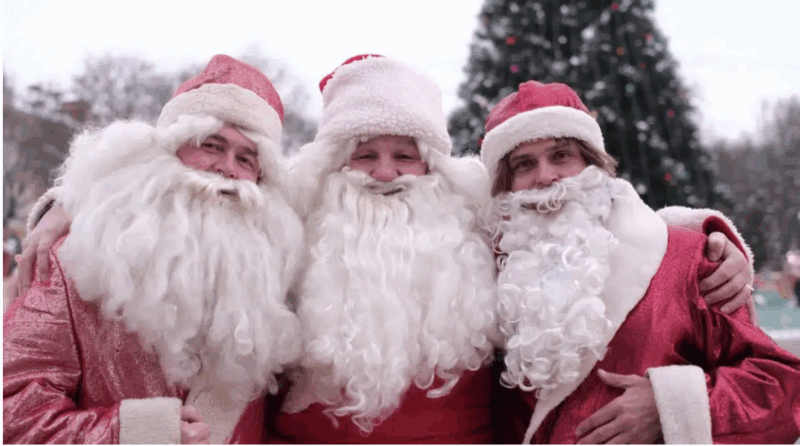
Professional Santas across America describe their work in terms that sound less like a seasonal gig and more like something they were meant to do. They talk about being “called” to the role, experiencing life-changing moments when they first don the red suit, and feeling a profound sense of purpose that extends far beyond spreading holiday cheer.
A study published in the Academy of Management Journal reveals that professional Santa work operates as a calling rather than simply a job, with Santas reporting the role provides deep personal, moral, or social significance. Researchers interviewed 53 professional Santas and drew on nearly 1,300 survey responses collected across several studies to understand how workers navigate a calling when they don’t perfectly match society’s expectations for the role.
To protect their identities, researchers assigned each Santa a pseudonym based on constellations and galaxies, reflecting both the professional Santa tradition of being addressed as “Santa” and the magical, otherworldly nature of the work.
Santa Apus, a Black professional Santa, described the moment he knew this was his path. After leaving a voicemail for a major retailer, the hiring manager gushed about his voice and presence. But when she learned he was African American, her tone shifted completely. “Are you African American? Are you Black?” she asked. When he confirmed, she told him, “We don’t hire any Black Santas or Hispanic Santas. We aren’t ready for that.”
The rejection stung, but it didn’t extinguish his sense of purpose. He saw Santa work as part of his ministry, explaining: “I want to make this part of my ministry. To help bring people closer to Christ and to help us celebrate Christ’s birthday.”
The research identified three distinct groups of professional Santas based on how closely they match the culturally embedded Santa prototype: white, male, white-haired, real-bearded, overweight, extroverted, able-bodied, heterosexual, and Christian. Those who naturally fit this mold described feeling confident about stepping into the role. Those who partially matched it struggled with feelings of inadequacy. And those who deviated significantly sometimes faced rejection or pushback from parts of the Santa community.
The Identity Struggle Behind the Beard
Santa Hercules, who identifies as introverted, described the internal tension of sitting in the chair during a mall visit. Kids would wave and call out to him, but inside he wrestled with doubt: “You’re sitting in the chair, and you’re in there. But at the same time, inside I’m going, ‘What the heck, man? You’re just Hercules, man. What the heck?’”
Santas who partially matched the prototype developed creative backstories to explain their deviations. A skinny Santa told parents he was a “healthy Santa,” joking with children about why he looked different: “What, how do you think I would look after I have been around to 4,978,296,485 homes and eaten their cookies?” A hearing-impaired Santa would point to his cochlear implant and tell children: “Well, that’s a microphone to the North Pole. Bernard, the head elf, is listening to what you’re talking about, because he doesn’t want Santa to make any mistakes.”
Another Santa who had lost 192 pounds worried about no longer fitting the part but reframed his transformation: “I’m more fit as Santa instead of fitting the part.”
These explanations helped bridge the gap between their actual characteristics and what people expected.
The Physical and Emotional Transformation
Many Santas described extensive preparation to embody the role. They bleach their beards multiple times in the weeks before their first booking, invest in expensive custom suits, and practice their “ho, ho, ho” laugh until it becomes natural. One Santa worked so hard on his laugh that it became automatic. He explained how he asked another professional Santa about his authentic-sounding laugh: “He goes, ‘I had to teach myself to laugh like that, so that it’s natural. It’s not a, “Ho, ho, ho.” That’s how I sound when I laugh.‘ So I really worked at [it]. Now that’s how I laugh.”
For some, the transformation felt almost spiritual. Santa Phoenix described the experience: “I’m not putting something fake on. It is me and I have to really become that person, or let that person become me, and let it flow through me.”
Female Santas face unique challenges in a role defined by masculinity. Santa Lynx described the physical toll of appearing male: “I actually have either a binder or I have trans-tape… I try to make the girls go into my spine, which I think I still have a bruise from January, but anyway, you have to make sure…because Santa doesn’t have them double-Ds.” She spends up to 90 minutes applying her beard and makeup, compared to the five to 10 minutes it takes naturally bearded Santas to prepare.
Despite receiving hate mail and being denied entrance to Santa school because of her gender, she persists. She recalled being told: “You can’t be in the Santa school.” When she asked why, the response was: “Well, the men and I were talking, and we figured it’d be distracting to you [to learn in a group full of men].” The organizer suggested: “We can enroll you in the Mrs. Claus school or you can have your elf come and take our elf courses.” But Santa Lynx believes Santa embodies something more universal: “Santa can embody that acceptance and joy and love and understanding.”
Two Paths: Year-Round Santa or Seasonal Role
The researchers discovered that professional Santas split into two camps when the season ends. Some live as Santa 365 days a year, wearing red daily, driving cars with Santa-themed license plates, and carrying Santa coins to hand out to well-behaved children they encounter.
One Santa explained his year-round commitment: “That’s where my heart is. And, that’s why, eight years ago, I decided I’d live this way year-round, because that is who I am.” Another described the constant visibility: “You’re never off. You’re never not Santa. And you lose a little bit of your identity because you can’t let your hair down and be yourself and do all that because you don’t know who’s watching you.”
Santa Cygnus described how the role has merged with his identity: “And now my circle of friends know that I do Santa. So, you asked to start with, ‘Should I call you Cygnus, Santa Cygnus, whatever?’ I’m accustomed to being called Santa Cygnus now, because people just do it. It’s kind of become part of me.”
Other Santas carefully compartmentalize the role. They enjoy the work tremendously during the season but return to being themselves for most of the year. One explained his boundary: “Personally, I don’t want to be Santa 24/7, and I also just think that there’s so much about me that I want to live me. I don’t want to live a character.”
Another Santa described the seasonal nature of his work: “I can work [Santa jobs] four months out of the year…I’m more Santa when I’m at work [portraying Santa Claus]. When you put the suit on, that’s when you have to be that person.”
The study found that how much Santas identify with the role determines whether they practice continuous or episodic calling enactment. Those who strongly identify with being Santa integrate it into every aspect of their lives. Those with lower identification enjoy the seasonal nature of the work and use the off-season to honor other parts of themselves.
Breaking Traditional Santa Stereotypes
Santas who significantly deviate from the traditional prototype often reinterpret what Santa represents. They focus on higher-order values like kindness, generosity, and unconditional love rather than specific physical characteristics.
Santa Reticulum, who is gay, argued that people often view Santa through too narrow a lens: “I think you also exclude a lot of people if you are just being Santa for Christians.” He worries that treating Santa as strictly Christian leaves people out and prefers to see Santa as someone who accepts everyone without judgment.
Santa Lepus, who is Jewish, described how he views the role: “Santa is a guy who is truly accepting of the world and not judgmental.” He sees Santa as transcending religious boundaries and focuses on universal values of acceptance.
Atheist Santas in the study described staying away from religious aspects entirely. Santa Equuleus explained his perspective: “All of the things I like about Santa Claus are not religious. It’s this idea of being kind to people with no expectation of anything in return, except maybe cookies and milk, and even that is not a requirement. It’s just you’re kind to people for the sake of being kind.”
Despite facing rejection and having to downplay certain characteristics, these non-traditional Santas uniformly described living the role year-round. They found that once they connected with Santa’s core values, they could fully identify with the role even while looking different from what society expects.
Inside the Professional Santa Community
The Santa world includes training schools, professional associations, and local networks. Organizations like the Fraternal Order of Real Bearded Santas and the International Brotherhood of Real Bearded Santas set standards for membership, though some have begun relaxing requirements. The IBRBS now accepts fake-bearded Santas as associate members, though only real-bearded Santas can become full voting members.
These communities provide support, training, and job referrals. One Santa described the camaraderie: “We meet once a month for lunch and we all dress up as summertime Santas and we go out with our red shirts and our red tennis shoes and our full beards and we have a luncheon. We get together and we share stories, especially with the younger ones that are coming in, the newer Santas to give them insight about this.”
Several mentioned attending multiple Santa schools to improve their craft, with one Santa earning what he called a “Master’s degree at SantaClausology.”
However, the community also enforces boundaries about who counts as a legitimate Santa. Some Santas described colleagues who use scooters or wheelchairs as “bad Santas” who should retire. Female Santas reported receiving pushback from multiple directions within the community.
Source: https://studyfinds.org/thousands-of-adults-say-becoming-santa-is-their-lifes-calling/



