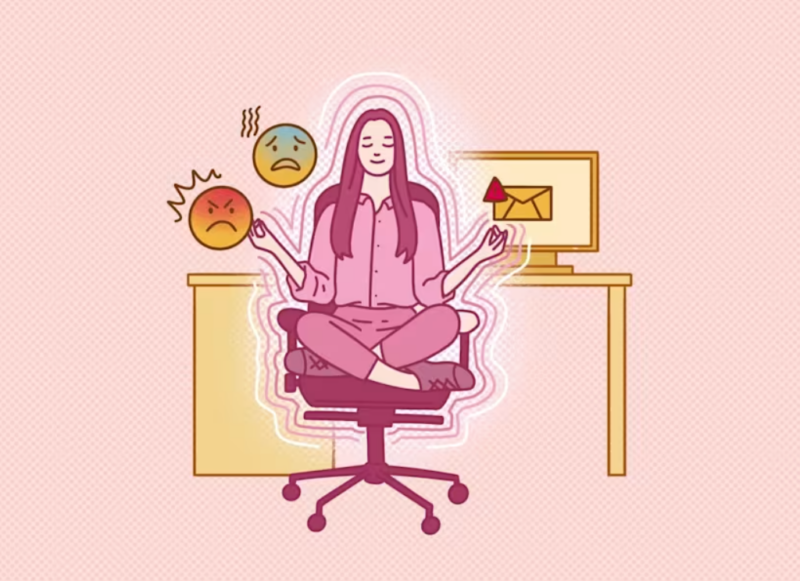
Emotional regulation is not about pushing aside your feelings but rather about being to able to respond to high-pressure situations at work with intention rather than impulsively.
In October last year, Ms Veenaa Subramaniam, 44, hit a “perfect storm” involving her work and personal life.
Weeks earlier, her father-in-law had suffered a stroke and her two children were just starting their year-end examinations.
The assistant director of a workforce development agency was also focused on a major work event, preparing a presentation for her board of directors and finalising a 10-year partnership deal ahead of a job transition in December last year.
“I felt that the demands were impossible for me to bear,” said Ms Veenaa. “My mind was in a constant loop of: ‘Who needs me most right now?”
With every pillar of her life requiring her full attention at the same time, she felt stretched beyond her limit and overwhelmed by having to be everything to everyone.
She said that she usually relies on family and close friends as a safety valve, often venting to them to relieve pressure when things get overwhelming.
However, Ms Veenaa realised that venting was not always effective, especially when the very people she leaned on were also stretched and struggling.
Phases like this may not happen often and are usually a confluence of factors, but in all likelihood, most people will experience periods like this sometime in their lifetime and still have to be functional at work.
As Ms Cindi Wirawan, the founder of Vibe Tribe, a Singapore-based professional networking community, put it: “We bring our whole selves to work whether we mean to or not.”
Regulating one’s emotions, experts said, is not just about surviving difficult periods. It is about the steady, ongoing practice of understanding and managing our responses to stress.
WHY EMOTIONAL REGULATION HELPS WITH OUTCOMES
They added that if one is able to successfully manage one’s emotions, this often translates into better workplace outcomes, from clearer decision-making to stronger professional relationships.
Mr Chris Wong, a clinical psychologist at Heartscape Psychology, said learning how to regulate our emotions is key.
“While it is normal and valid for us to experience various emotions, learning to regulate them can allow us to manage or respond to them in a more proactive, helpful manner rather than a reactive, unhelpful way,” he said.
Ms Wirawan said that successful individuals are those who can feel stressed or frustrated and still think clearly, communicate effectively, and make good decisions.
Without regulation, everything becomes reactive, which can result in emails fired off in the heat of the moment, decisions driven by anxiety rather than strategy and the breakdown of relationships when people are operating in a constant state of fight-or-flight.
“For many companies, emotional intelligence is a prerequisite for senior leadership roles or for certain promotions,” she said.
Mr James Chong, principal counsellor at The Lion Mind, added that in the workplace, how one manages emotions affects how others perceive one’s reliability, judgment and leadership capacity.
Beyond workplace performance, however, emotional regulation is also a skill for life more broadly.
Mr Chong said that emotional regulation is part of a healthy lifestyle, much like maintaining regular sleep or eating routines.
“When regulation becomes habitual, it supports both well-being and long-term sustainability at work.”
HOW TO REMAIN CALM DURING STORMY MOMENTS
When it comes to personal situations such as grief or conflict at home that spill into the workplace, experts said there is no single correct way to navigate them. However, discretion is key, they added.
Mr Wong said decisions about disclosure to one’s colleagues depend on how emotionally safe a person feels, and emphasised that there is no obligation to share if one does not wish to.
Ms Wirawan agreed that full disclosure is not necessary and that broad strokes outlining the general nature of the predicament are often enough.
Individuals should first consider what they need from work — whether that is time off, a lighter workload or simply space. They should then share only what is necessary to secure that support from their bosses.
“Choosing privacy can be a form of self-respect, allowing emotions to be processed without the added pressure of managing others’ responses,” added Ms Estee Ling, co-founder and director of clinical operations at Sol Therapy.
She added that there are some simple ways to regulate one’s emotions at work.
These include:
-
Prioritising tasks while one is under pressure, rather than scrambling to complete every task
-
Pausing briefly before responding to a tense email
-
Intentionally carving out short moments between tasks to check in with your body and release any tension that has built up by stretching or breathing.
Mr Chong cited regulation techniques that can be done within seconds, such as slow, controlled breathing, unclenching muscles, grounding yourself through physical sensations such as feeling your feet on the floor, or drinking a glass of cold water.
Another trying scenario at the workplace where regulating emotion is key is when there is tension among colleagues, such as someone missing a deadline, dropping the ball, or repeatedly asking for help when you are already stretched thin.
In these situations, delaying immediate responses to emotionally charged messages often allows reactions to soften, said Ms Ling.
For example, stepping away from a trying situation and then drafting a reply through email rather than having a face-to-face conversation can prevent escalation.
She added that shifting questions from: “Why are they like this?” to: “What might be happening that I’m not seeing?” can help individuals see the situation from a different perspective and open room for resolution.
Experts said that when it comes to regulating emotions, it’s not about just being calm all the time – as is expected of those who are constantly under fire in high-stress role such as traders, doctors or frontline staff.
For these individuals, emotional regulation does not mean removing the stress but managing it in the moment, said Mr Chong.
Ms Ling added that in these high-pressure environments, regulation is about “staying anchored while under strain”.
“You may still feel urgency, pressure, frustration, or emotional weight and at the same time remain accountable to your role and responsibilities.”
“You may still feel urgency, pressure, frustration, or emotional weight and at the same time remain accountable to your role and responsibilities,” she said.
For roles that demand constant responsiveness or are emotionally taxing, setting boundaries is critical, said experts.
Ms Ling said in emotionally demanding roles, setting boundaries means caring about the work without taking on “the entire emotional weight of a team or situation”.
Source : https://www.channelnewsasia.com/today/mental-health-matters/stress-work-emotion-regulating-5947446



