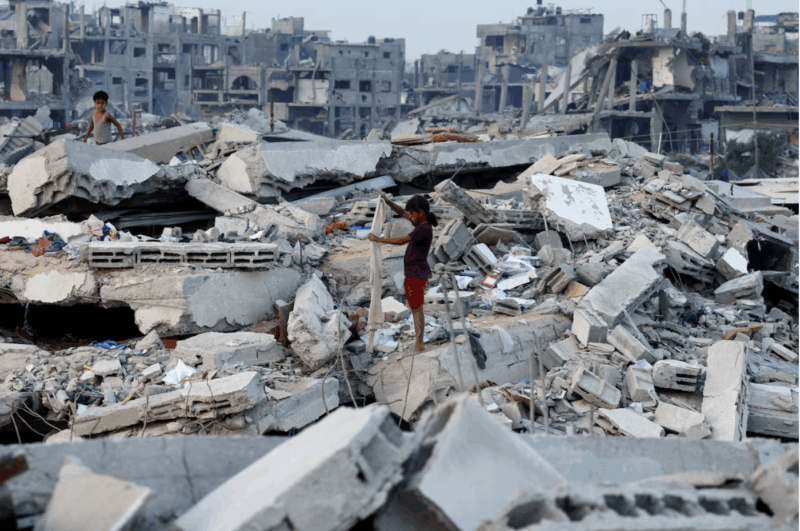
The U.S. gathered intelligence last year that Israel’s military lawyers warned there was evidence that could support war crimes charges against Israel for its military campaign in Gaza – operations reliant on American-supplied weapons, five former U.S. officials said.
The previously unreported intelligence, described by the former officials as among the most startling shared with top U.S. policymakers during the war, pointed to doubts within the Israeli military about the legality of its tactics that contrasted sharply with Israel’s public stance defending its actions.
Two of the former U.S. officials said the material was not broadly circulated within the U.S. government until late in the Biden administration, when it was disseminated more widely ahead of a congressional briefing in December 2024.
The intelligence deepened concerns in Washington over Israel’s conduct in a war it said was necessary to eliminate Palestinian Hamas fighters embedded in civilian infrastructure — the same group whose October 7, 2023, attack on Israel sparked the conflict. There were concerns Israel was intentionally targeting civilians and humanitarian workers, a potential war crime which Israel has strongly denied.
U.S. officials expressed alarm at the findings, particularly as the mounting civilian death toll in Gaza raised concerns that Israel’s operations might breach international legal standards on acceptable collateral damage.
The former U.S. officials Reuters spoke to did not provide details on what evidence — such as specific wartime incidents — had caused concerns among Israel’s military lawyers.
Israel has killed more than 68,000 Palestinians during a two-year military campaign, say Gaza health officials. Israel’s military has said at least 20,000 of the fatalities were combatants.
Reuters spoke to nine former U.S. officials in then-President Joe Biden’s administration, including six who had direct knowledge of the intelligence and the subsequent debate within the U.S. government. All spoke on the condition of anonymity because of the sensitivity of the matter.
Reports of internal U.S. government dissent over Israel’s Gaza campaign emerged during Biden’s presidency. This account — based on detailed recollections from those involved — offers a fuller picture of the debate’s intensity in the administration’s final weeks, which ended with President Donald Trump’s inauguration in January.
Israeli Ambassador to the U.S., Yechiel Leiter, declined to comment when asked for a response about the U.S. intelligence and the internal Biden administration debate about it. Neither the Israeli prime minister’s office nor the Israeli military spokesperson immediately responded to requests for comment.
DEBATE INTENSIFIED IN FINAL DAYS OF BIDEN TERM
The intelligence prompted an interagency meeting at the National Security Council where officials and lawyers debated how and whether to respond to the new findings.
A U.S. finding that Israel was committing war crimes would have required, under U.S. law, blocking future arms shipments and ending intelligence sharing with Israel. Israel’s intelligence services have worked closely with the U.S. for decades and provide critical information, in particular, about events occurring in the Middle East.
Biden administration conversations in December included officials from across the government, including the State Department, the Pentagon, the intelligence community and the White House. Biden was also briefed on the matter by his national security advisers.
The White House did not immediately respond to a request for comment. “We do not comment on intelligence matters,” a State Department spokesperson said in response to emailed questions about Reuters reporting.
The American debate about whether the Israelis had committed war crimes in Gaza ended when lawyers from across the U.S.
government determined that it was still legal for the U.S. to continue supporting Israel with weapons and intelligence because the U.S. had not gathered its own evidence that Israel was violating the law of armed conflict, according to three former U.S. officials.
They reasoned that the intelligence and evidence gathered by the U.S. itself did not prove the Israelis had intentionally killed civilians and humanitarians or blocked aid, a key factor in legal liability.
Some senior Biden administration officials feared that a formal U.S. finding of Israeli war crimes would force Washington to cut off arms and intelligence support — a move they worried could embolden Hamas, delay ceasefire negotiations, and shift the political narrative in favor of the militant group. Hamas killed 1,200 people and abducted 251 in its October 7, 2023, attack, prompting Israel’s military response.
The decision to stay the course exasperated some of those involved who believed that the Biden administration should have been more forceful in calling out Israel’s alleged abuses and the U.S. role in enabling them, said former U.S. officials.
President Trump and his officials were briefed by Biden’s team on the intelligence but showed little interest in the subject after they took over in January and began siding more powerfully with the Israelis, said the former U.S. officials.



