While Penang’s chief minister told CNA that the state retains strong interest from American and Chinese multinational corporations, experts fear that a substantial tariff rate by Washington for the semiconductor sector could diminish its role in the global supply chain.
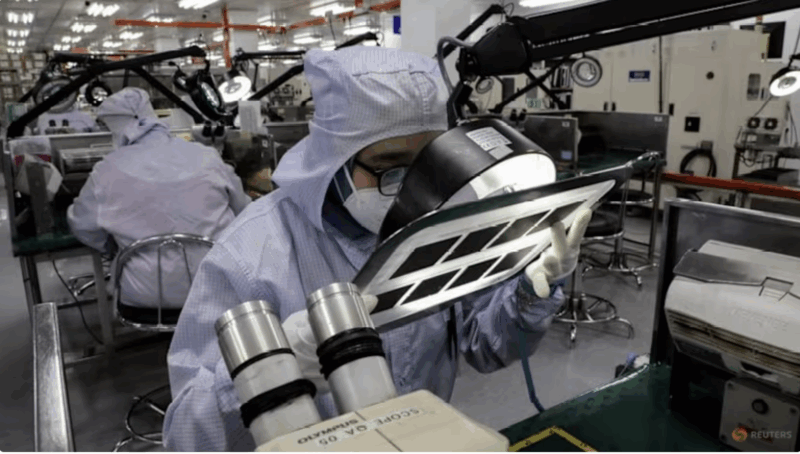
A threat by United States President Donald Trump to impose tariffs on semiconductor imports has cast a dark cloud over Penang, with experts saying it could derail a boom which has propelled the northern Malaysian state into a powerhouse in this essential technology sector.
Yet Penang’s Chief Minister Chow Kon Yeow is more upbeat, telling CNA that the state – as well as the country – remains in a “relatively competitive position” to draw investments.
Speaking at a White House dinner on Sep 4 with tech bosses, Trump said: “Chips and semiconductors – we will be putting tariffs on companies that aren’t coming in. We will be putting a tariff very shortly.”
He did not give an exact deadline or rate for the planned levy, but added: “We will be putting a very substantial tariff, not that high, but fairly substantial tariff with the understanding that if they come into the country, if they are coming in, building, planning to come in, there will not be a tariff.”
While there has been no formal announcement of any sectoral tax on semiconductors by the US for now, the writing may be on the wall.
On Sep 26, Trump announced a new sectoral levy imposing a 100 per cent tariff on any branded or patented pharmaceutical product, unless a company builds its pharmaceutical manufacturing plant in America.
The move made waves in neighbouring Singapore, where pharmaceutical exports are worth about S$4 billion (US$3.08 billion) and make up 13 per cent of its domestic exports to the US.
Now, industry players in Malaysia are waiting to see if Trump enact similar tariffs on the semiconductor chips industry as previously hinted. Penang plays an outsized role in the global semiconductor supply chain despite being Malaysia’s second smallest state.
Dubbed the “Silicon Valley of the East” by observers, the northern state accounts for 5 per cent of global semiconductor exports, according to state government figures.
It is also an investment destination for some of the bigger American multinational corporations (MNCs) in the sector including Intel, Advanced Micro Devices (AMD), Micron and Infineon.
Penang’s importance as a chip hub underlines Malaysia’s significance to the global supply chain, with the Southeast Asian nation accounting for 13 per cent of global testing and packaging of the product, according to the Malaysian Investment Development Authority.
On one hand, Penang officials are sanguine that its semiconductor industry can stay robust, citing how despite the current uncertain climate, companies are still exploring expansion opportunities.
In a written response to queries from CNA, Chow said that with Malaysia’s reciprocal tariff rate set at 19 per cent and sectoral tariffs on semiconductors not yet formally announced, the country and Penang remain in a “relatively competitive position” to draw investment.
“While global investment sentiment experienced some uncertainty in recent years, we’ve seen renewed engagement from US companies, with several returning to explore expansion opportunities through (the state’s investment promotion agency) InvestPenang.
“Increasingly, companies are adopting a forward-looking approach, designing strategies that extend beyond current political cycles in the US,” Chow added.
He quoted Malaysia’s investment figures, citing how in the first half of 2025, the US is the highest contributor of approved manufacturing foreign direct investment (FDI) in Penang with a total investment value of RM2.6 billion (US$615.5 million), representing a quarter of the northern state’s approved manufacturing investment.
Chow said this indicates Penang’s attractiveness for US companies presently.
On the other hand, economists told CNA that Penang should be bracing for impact, amid warning signs from industry leaders in Malaysia and some corporations holding pause on their investments.
The experts added that a high semiconductor tariff rate of potentially 80 per cent or more could directly impact the sector and reduce foreign investment due to the state’s high exposure to US exports.
Based on government data for the first half of this year, Penang accounted for around 55 per cent of Malaysia’s exports to the US, dominated by semiconductors as well as electrical and electronics.
Malaysian-American economist Woo Wing Thye, a distinguished fellow at the think tank Penang Institute, told CNA that a high levy would hurt the sector and raise prices of products made in Penang – to the extent that it may no longer be realistic to operate there and export to the US.
“If the semiconductor tax is announced at 80 per cent or more, prices will go up and this will hurt the industry,” said Woo, who is also vice-president for the United Nations Sustainable Development Solutions Network’s Asia office.
He added that tariffs would certainly hurt the high-tech semiconductor firms, and while chips made in Penang are typically made for mid-level tech products such as household items like vacuum cleaners, they will also not be spared from the adverse effects of an additional hefty trade levy.
Wong Siew Hai, president of the Malaysia Semiconductor Industry Association, told CNA that “Penang’s semiconductor eco-system momentum remains intact”.
He cited how the state is the top contributor of manufacturing FDIs in Malaysia, with a 20 per cent share of the country’s total from January to June.
“A big portion of this comes from the electrical, electronics and semiconductor companies. The tariffs for semiconductors are still at zero, no impact as of now. Businesses continue as normal,” said Wong.
“We hope the US will make a wise decision in the future in order to help both the semiconductor industry and allow the US companies (in Penang) to flourish.”
In fact, some firms are expanding operations in Penang, including the Nasdaq-listed Analog Devices, which produces integrated circuits and software.
The firm’s ASEAN business director George Chia was quoted as saying during a media roundtable on Oct 2 that the company was expanding its presence in Penang and was keen on hiring locals for its factory workforce.
Chia lauded Penang’s role as a “driving force” in backend operations in the industry, and praised Malaysia in the sector of integrated circuit design and innovation.
“Other countries are still initiating efforts to understand the semiconductor landscape. Malaysia has already made significant progress,” he added.
Penang’s dense ecosystem of suppliers clustered around the Bayan Lepas and Batu Kawan area is concentrated with companies involved in assembly, testing and advanced packaging of semiconductors.
This includes US global chipmaker AMD, which announced in August a new office and engineering lab facility in Bayan Lepas, which will house 1,200 employees.
Source: https://www.channelnewsasia.com/asia/penang-tariffs-semiconductor-chips-silicon-valley-5399886



