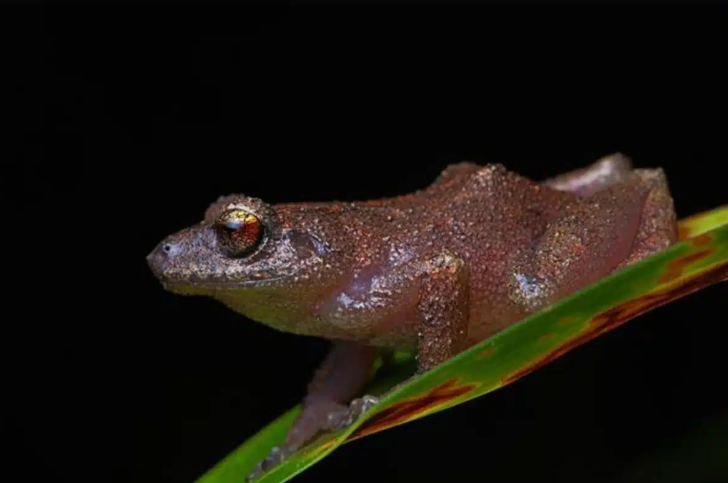
Deep in the misty highlands of northwestern Peru, where ancient mountains pierce the clouds and few humans dare to tread, scientists have uncovered three entirely new species of frogs. These amphibians have been quietly living their lives in one of Earth’s most remote corners.
The newly discovered amphibians call the Cordillera de Huancabamba home, a rugged mountain range so treacherous that even seasoned researchers describe it as having “steep, exposed” ridges with “loose and muddy” soil where “the weather can be very changeable.” Apparently, it’s also where evolution has been busy cooking up new life forms, according to new research published in Evolutionary Systematics.
These three species were discovered in a region that has barely been explored by scientists since the early 1990s. Despite habitat loss in the area, the international research teams suspect there could be even more undiscovered species lurking in these remote peaks.
A High-Altitude Game of Hide-and-Seek
Finding new species in 2025 might seem unlikely, but scientists are still uncovering new life forms regularly, particularly in remote mountainous regions. The Cordillera de Huancabamba sits at elevations around 2,600 to 2,900 meters above sea level, roughly 8,500 to 9,500 feet up, where the air is thin and conditions can be harsh.
Each frog has adapted to its own specific environment. Pristimantis yonke, the smallest of the three new species, has made itself at home inside bromeliads—spiky, cup-shaped plants that collect water high up in the forest canopy. All specimens of this species were found 1-3 meters (3.3 to 9.8 feet) off the ground, tucked away in these natural water tanks.
Meanwhile, Pristimantis chinguelas prefers life on the rocky, exposed cliffsides, calling from leaves up to 1.8 meters high. Pristimantis nunezcortezi was discovered near rocky streams in secondary forest areas.
Lead researcher Germán Chávez and his team conducted multiple expeditions over several years, often working through both rainy and dry seasons. They walked 5-6 hours per night with headlamps to search different habitats.
DNA Analysis Confirms New Species
The research team used modern genetic analysis to confirm that these were indeed new species, not just variations of existing frogs. If two species differ by more than 3% in their DNA, they’re considered separate species, and some of these frogs had 4-6% differences from their nearest relatives.
The researchers found that many previously discovered species in this region haven’t been seen since they were first described or have only been spotted again after disappearing for many years. The research team estimates that nearly 50% of the amphibian species in this region are endemic, meaning they exist nowhere else on Earth.
The Meaning Behind Their Names
The researchers chose names that honor both the landscape and local culture. Pristimantis chinguelas gets its name from Cerro Chinguelas, the mountain where it was found, and where researchers note “a handful of explorers in the late ’70s started the scientific research in the Cordillera de Huancabamba.”
Pristimantis yonke is named after “yonke” or “yonque,” which the researchers describe as “a traditional drink made from sugar cane distillation and only drunk by local people from northwestern Andes to keep themselves warm during their journeys through the cold highlands, which may include night camps to get to other villages.”
The third species, Pristimantis nunezcortezi, honors Elio Nuñez-Cortez, a Peruvian ornithologist who the researchers say contributed to conservation efforts in the region.
From 2001 to 2023, wildfires, farming, and cattle grazing spread further into the region, destroying almost 12,400 acres of natural habitat. Large wildfires hit the area again in November 2024, though researchers don’t yet know if these affected the newly discovered species’ habitats.
All three new species were classified as “Data Deficient” under conservation guidelines, meaning there simply isn’t enough information yet to determine how threatened they might be. The researchers estimate that Pristimantis chinguelas occupies an area smaller than 4 square miles, while only two Pristimantis nunezcortezi have been found, both at the same location.
The world’s species are fleeting in the face of climate change, but the discovery of new life forms is not yet lost. In remote regions like the Cordillera de Huancabamba, many more species could one day be discovered by scientists brave enough to go searching for them.
Source : https://studyfinds.org/three-new-frog-species-peru/



