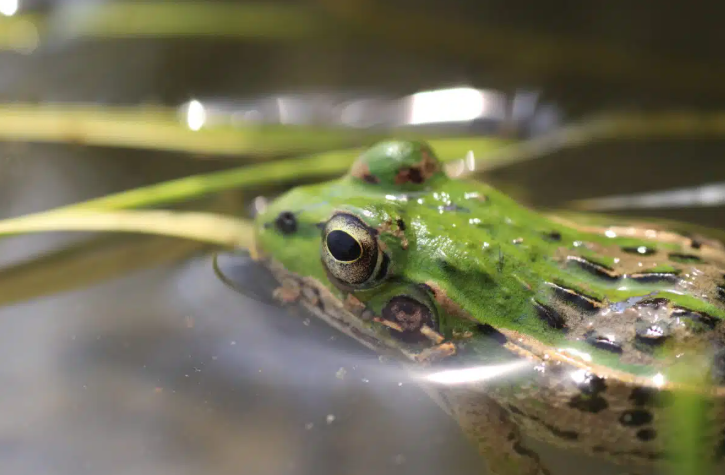
These amphibians are all too happy to endure a few stings for a decent meal.
Japanese pond frogs can eat some of the world’s most venomous insects and apparently hop away from the meal unharmed. Research reveals these amphibians tolerate repeated stings from giant hornets carrying enough venom to kill animals many times their size.
Scientists in Japan tested how pond frogs responded to three species of hornets, including Vespa mandarinia, the Asian giant hornet notorious for its painful, potentially lethal sting. About 79% of the frogs that attacked these giant hornets successfully consumed them despite being stung multiple times.
A single sting from V. mandarinia carries enough venom to reach the LD50 dose for a 270-gram mouse. The frogs in this study ranged from just 6 to 76 grams. Some frogs were stung directly in the face, eyes, tongue, and throat yet showed no signs of injury or distress.
The hornets’ stings did not kill or harm any of the frogs, according to Shinji Sugiura, a researcher at Kobe University’s Graduate School of Agricultural Science who published the findings in the journal Ecosphere. The frogs resumed normal behavior immediately after consuming their prey.
Face to Face with Venom
The experimental setup was simple but revealing. Researchers placed hungry pond frogs (Pelophylax nigromaculatus) in plastic containers with worker hornets that had been stimulated to sting. Digital cameras recorded what happened next.
Most frogs attacked the hornets without hesitation. Video footage showed hornets repeatedly extending their stingers and jabbing the frogs during these encounters. The attacks lasted several seconds, with hornets stabbing at the frogs’ mouths and faces. Yet the frogs persisted, eventually swallowing their dangerous prey whole.
Out of 45 frogs tested, 43 attacked the hornets. Of those, 37 successfully consumed them despite the defensive stings. The frogs digested the hornets over the next few days, excreting undigested body parts in their feces.
The study tested three hornet species of increasing size and venom potency. Japanese yellow hornets (V. simillima) were consumed by 93% of attacking frogs. Yellow-vented hornets (V. analis) had an 87% consumption rate. Even the formidable Asian giant hornets were consumed by 79% of frogs that attacked them.
Built to Handle Pain
Hornet venom is a complex cocktail designed to cause maximum suffering. It contains biogenic amines like serotonin that trigger sharp, intense pain. Small peptides called vespakinins amplify the hurt. Enzymes break down tissue and can cause system-wide damage including cardiac dysfunction and blood cell destruction in sensitive animals.
These chemical weapons evolved primarily to defend hornet colonies from vertebrate predators like birds and mammals. Hornet stings cause intense, sharp pain in humans and can trigger severe allergic reactions that have caused human fatalities.
Frogs appear to tolerate both the pain and the toxicity based on their behavior. They showed no behavioral changes suggesting discomfort and tolerated both venom effects and pain in ways that set them apart from most vertebrates.
The research found that larger frogs had better success consuming hornets. This size-dependent pattern suggests bigger frogs may have proportionally greater venom tolerance, though the exact mechanism remains unknown.
Evolutionary Mismatch
Frogs and hornets cross paths frequently in Japanese wetlands. Hornet workers visit pond edges to collect water for their colonies, where they encounter hunting frogs. Previous studies have found hornet remains in the stomach contents of wild pond frogs, confirming this predator-prey relationship exists in nature.
But hornets didn’t evolve their stingers with frogs in mind. Social wasps developed venomous defenses mainly to protect their colonies from raiders trying to steal larvae and pupae. Birds and mammals pose the primary threat to hornet nests, so the venom evolved to deter warm-blooded attackers.
Frogs rarely attack hornet colonies. They prey opportunistically on individual workers foraging around water. Since hornets didn’t face strong selection pressure from frog predation, their venom may simply be ineffective against amphibian physiology.
Sticky saliva that frogs produce might offer some protection by coating their mouth and throat during attacks, though this hasn’t been tested. Frogs swallow prey whole and alive, so their digestive systems may have evolved robust linings resistant to chemical and physical damage from struggling, stinging insects.
Medical Implications
Understanding how frogs tolerate hornet venom could help scientists study pain mechanisms and venom responses. The study suggests frogs may have physiological traits that help them tolerate both the pain and the toxic effects of hornet venom, although the exact mechanism is still unknown.
Hornet stings cause serious reactions in humans each year. If scientists can identify how frog tissues resist venom damage or how their nervous systems respond to pain signals, those discoveries might eventually inform research on venom responses in other animals.
Other animals have evolved similar defenses through different paths. Horned lizards developed blood proteins that neutralize harvester ant venom. Grasshopper mice have mutations in pain receptors that make scorpion venom painless. Each species offers unique insights into how evolution solves the problem of venomous prey.
Frogs represent a particularly useful model because they’re vertebrates like humans, sharing more physiological similarities than insects or other invertebrates. Their tolerance mechanisms might translate more directly to human medicine than adaptations found in distantly related animals.
The research leaves key questions unanswered. Do frogs learn to avoid hornets after being stung, or do they continue attacking them repeatedly? Does the venom fail to penetrate frog tissues, or do frogs detoxify it rapidly? What specific proteins or cellular mechanisms provide protection?
Future studies comparing venom exposure across multiple trials could test whether frogs develop learned aversion to painful prey. Biochemical analysis of frog blood and tissues after stings might reveal detoxification pathways. Genetic studies could identify mutations in pain receptors similar to those found in grasshopper mice.
Source : https://studyfinds.org/frogs-shrug-off-venomous-lethal-hornet-stings/



