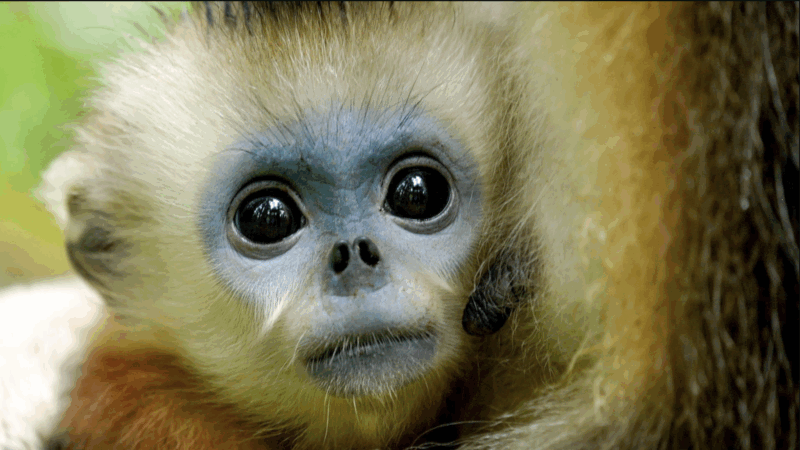
Until the 1980s people roamed the mountains of Shennongjia in central China hunting monkeys for their meat and fur.
Poor farmers were still clearing vast areas of trees, and as their environment collapsed around them, so did the local population of golden snubbed-nosed monkeys, dropping below 500 in the wild.
This was the situation when new graduate Yang Jingyuan arrived in 1991, still in his early 20s.
“The monkeys’ home was being destroyed by logging so their numbers were going down fast,” he says. “Now it’s being protected, and the monkey figures are really improving.”
These days Professor Yang is the director of the Shennongjia National Park Scientific Research Institute and probably no one knows this species better than he does.
Prof Yang, 55, has spent his entire working life trying to understand and protect this endangered sub-species of snub-nosed monkeys, which exist only in these mountains in Hubei province, and he took us into the forest to meet them.
I asked if it was true that he now understood what many of their noises meant.
“Yes,” he said. “Yeeee is telling others the area is safe. They can come over. Wu-ka means it’s dangerous. Be careful.”
And, sure enough, there he was making various noises as the monkeys came down out of the trees, holding our hands, touching us and checking out the humans.
As we sat down on the ground to put them at ease, he said that these animals have a very complex social structure.
With baby monkeys jumping into my lap and crawling over us to see what was going on, Prof Yang explained how their groups break down.
One male head of a family group might have three to five wives, plus their children. Then families come together to form a larger band that could be more than a hundred.
Bachelor males form their own groups, which at times stand guard. Females have “affairs” behind their husband’s backs, causing tension and fights break out not only when a male takes control of a family from an existing male head but when an entire “tribe” of monkeys battles with another for control of territory.
Six-year-old females know when it is time to leave their family and join another so as to prevent inbreeding and the animals – which live until around 24 years old – also know when it is time for them to die.
Near the end of their lives, we were told, they find a quiet place by themselves and go out alone. The rangers said the spots were so secluded that, over decades, they had never been able to find a monkey’s body after this had happened.
That these unique animals can now exist in this way over an area of 400 square kilometres (155 square miles) is very different to how it was.
Though the national park was created in 1982, one 49-year-old ranger who grew up in the area, Fang Jixi, said that it took many more years for struggling farmers to stop destroying this environment.
“People were very poor in these mountains and hunger was a real concern. There was no concept of protecting wild animals,” he said.
“Even after logging was banned there were still people illegally felling timber. If they didn’t cut down trees, how would they have money? There were also people secretly hunting here to survive. It was only after a long period of building awareness that the consciousness of local farmers changed.”
Part of this awareness was bringing these farmers on board to become protectors of the forest rather than wreckers of it.
“When the change occurred it was the scientists who told us you can actually come and work with us. You can have a job here to help the animals,” Mr Fang said.
Now he is part of a team that patrols the hills, keeping an eye out for poachers and, most importantly, looking for where the monkeys are so that researchers can study how and where they sleep, forage and give birth.
Finding them can be difficult because the animals can cover an area through the treetops in minutes that a human would need an hour to walk.
What’s more, these fascinating primates are not naturally so open to human interaction, especially given how dangerous such contact could have been in the past.



