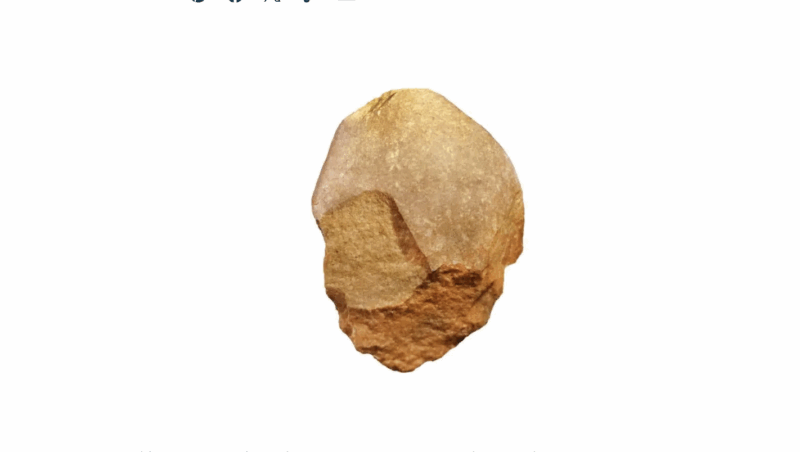
Our ancient ancestors weren’t fumbling with crude rocks. A groundbreaking archaeological discovery in Kenya reveals they had mastered a stone tool technology so effective that they stuck with it for roughly 300,000 years, even as their world transformed around them.
Researchers working at Namorotukunan, a site in the Turkana Basin of northern Kenya, have uncovered three distinct layers of stone artifacts spanning from 2.75 million to 2.44 million years ago. The consistency across hundreds of thousands of years and through dramatic climate shifts shows that what we might dismiss as “primitive” was actually an enduring adaptation that worked exceptionally well.
Sharp Minds, Sharp Edges
Excavations yielded 1,290 stone artifacts from three separate time periods. According to the research team led by archaeologist David Braun of George Washington University and geologist Dan Palcu of Utrecht University, the toolmakers had a clear focus: producing sharp-edged flakes rather than heavy-duty hammering tools.
Between 79 and 94 percent of the artifacts recovered were sharp-edged flakes and fragments. Evidence from one bone specimen in the 2.58-million-year-old layer shows butchery marks, confirming that at least some of these tools were used to process animal carcasses. For early hominins living in increasingly open habitats, access to meat and marrow would have provided crucial calories.
Choosy About Rocks
The study, published in Nature Communications, reveals something unexpected about cognitive abilities. Ancient toolmakers were highly selective about their raw materials, showing a marked preference for fine-grained chalcedony despite the abundance of other rock types, including basalt.
Chalcedony, a type of quartz, fractures predictably and produces exceptionally sharp edges. Basalt was readily available and would later become the overwhelmingly preferred material at younger sites in the region. Yet the Namorotukunan toolmakers consistently chose chalcedony across all three time horizons, making up 58 to 69 percent of their raw materials.
This wasn’t random. Selection of specific rock types demonstrates that these hominins understood mechanical properties and made deliberate choices to optimize their results. This level of selectivity matches or exceeds the raw material preferences seen at much younger archaeological sites.
Toolmakers weren’t transporting stone over long distances. Ancient braided river systems deposited the cobbles directly adjacent to all three archaeological sites. The selectivity was about choosing the right rock from what was locally available.
When the World Dried Out
The site sits within sediments that record major environmental upheaval in East Africa during the late Pliocene. Around 3.44 million years ago, the area was a humid floodplain near a permanent water body. Yearly rainfall may have reached around 855 millimeters, one of the highest values documented in this region.
Between 2.8 and 2.7 million years ago, everything changed. Landscapes transitioned into river channels and floodplains as the paleolake shoreline retreated. Yearly precipitation plummeted to under 300 millimeters. Vegetation shifted too, with increases in grasses characteristic of more open, arid habitats and a spike in charcoal indicating widespread wildfires.
The oldest tool-bearing layer at Namorotukunan dates to 2.75 million years ago, right as this major drying trend was taking hold. The second layer sits at 2.60 million years ago, and the third at 2.44 million years ago. Around 2.2 million years ago, the area was flooded by an ancient lake, ending the archaeological record at this location.
Filling a Critical Gap
Before this discovery, the time period between roughly 3.0 and 2.5 million years ago was poorly understood in the Koobi Fora Formation due to a major erosional event. Namorotukunan fills this gap and represents the earliest known evidence of this technology in the region.
Only four localities in eastern Africa have yielded similar artifacts older than 2.6 million years ago: Ledi-Geraru and Gona in Ethiopia, Nyayanga in western Kenya, and now Namorotukunan. Most of these earlier sites provide narrow snapshots of a single moment. Namorotukunan offers something different: a view across three distinct time periods.
The research team used magnetic analysis of rocks combined with the age of volcanic ash layers to establish precise dates. Comparisons of the Namorotukunan artifacts to other early stone tool assemblages revealed clear patterns. Technological attributes closely resemble other early sites rather than younger assemblages or the earlier technology from Lomekwi 3 in Kenya.
Source : https://studyfinds.org/oldowan-stone-tools-used-for-300000-years-perfect



