Study Shows Quick Fixes For Ice Loss Are Too Costly and Risky
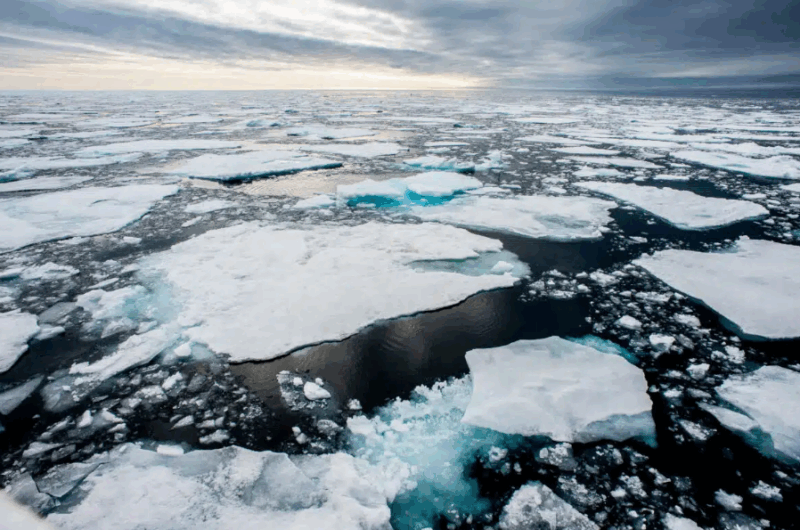
Forty-six polar scientists just delivered a sobering verdict on ambitious schemes promising to rescue Earth’s melting ice through massive technological interventions. Their conclusion? These plans are infeasible, prohibitively expensive, and could create serious new environmental risks.
Published in Frontiers in Science, this sweeping analysis examined five major proposals that have captured headlines as potential solutions to rapid ice loss in the Arctic and Antarctica. These range from aircraft spraying particles into the atmosphere to block sunlight, to constructing underwater barriers to shield glaciers from warm ocean water.
After evaluating each scheme across scientific feasibility, environmental risks, and governance challenges, the international research team concluded that none deserve serious consideration for the coming decades.
As the authors wrote in the paper’s abstract: “We find that the proposed concepts would be environmentally dangerous. It is clear to us that the assessed approaches are not feasible…”
The timing carries particular weight. With global temperatures now regularly exceeding 1.5°C above pre-industrial levels and polar ice loss accelerating, some researchers and engineers have promoted technological “fixes” as necessary alternatives to eliminating fossil fuel emissions.
Martin Siegert from the University of Exeter, who led the study with experts from six continents, argues these proposals offer false hope while potentially delaying real climate solutions.
Why Each Geoengineering Plan Falls Short
Consider stratospheric aerosol injection, the most technically feasible option examined. Aircraft would spray particles into the upper atmosphere to reflect sunlight back to space, mimicking how volcanic eruptions temporarily cool the planet. Yet the study found it would be completely ineffective during polar winter months when there’s no sunlight to block. The researchers estimate this approach would require 60,000 flights annually with billions in ongoing operations costs.
More dramatic schemes fared worse. One proposal involves building underwater “sea curtains” to block warm water from reaching Antarctic glaciers. According to estimates cited in the paper, such barriers could cost up to $80 billion for an 80-kilometer structure spread over a decade. The work would happen in some of Earth’s most inaccessible waters. Research shows that 56% of research cruises to the target region “experienced at least partial disruption due to sea ice or had significant difficulty entering or exiting the area,” while 22% “were unable to access the region altogether.”
Several proposals would deliberately add materials to polar ecosystems. One calls for scattering glass beads across Arctic sea ice to increase its reflectivity. According to research cited in the paper, this would require “approximately 360 megatons annually” of glass beads. The Arctic Ice Project, which aimed to test this technology, “was recently shut down after ecotoxicological tests revealed potential risks to the Arctic food web.”
Environmental and Political Roadblocks
The study highlights massive environmental uncertainties across all proposals. Antarctica operates under an international treaty system requiring consensus among dozens of countries. Any large-scale intervention needs approval from this system, which has never authorized projects at the proposed scales.
At the most recent Antarctic Treaty meeting referenced in the paper, “the CEP advised the ATCM that a precautionary approach should be taken towards geoengineering activities and that, at this point, geoengineering methods in the Antarctic should not be conducted due to their unknown environmental consequences.”
Arctic interventions face different but equally daunting challenges. Most of the region falls under national jurisdictions of eight Arctic countries, including Russia. Current geopolitical tensions make coordinated action unlikely, while Indigenous communities whose traditional ways of life depend on polar ecosystems have already voiced strong opposition.
The Crushing Financial Reality
The financial mathematics alone are staggering. Beyond initial costs measured in hundreds of billions of dollars, most proposals would require continuous maintenance and operation for decades or centuries. If interventions were ever stopped, the study warns of “termination shock,” which it describes as “the rapid and severe warming that could occur by the unmasking of ongoing GHG emissions if any future large-scale deployment of solar geoengineering were halted.”
These calculations don’t include potential lawsuits, insurance costs, or compensation for unintended consequences crossing international borders. Unlike proven climate solutions such as renewable energy, none of the geoengineering proposals have established supply chains, manufacturing capabilities, or operational experience at scale.
The research team notes a troubling pattern where fossil fuel companies have funded geoengineering research while continuing to expand oil and gas production. The paper draws a parallel to how “tobacco companies once promoted filtered cigarettes as a way to reduce the risk of cancer without reducing the consumption of tobacco.”
Proven Climate Solutions Work Better
According to climate scenario modeling cited by the authors, current climate policies already provide a roughly one-in-five chance of limiting warming to 1.5°C if fully implemented. Strengthening these policies offers about a four-in-five chance of limiting warming below 2°C.
Rapid decarbonization would begin stabilizing global temperatures within 20 years of reaching net-zero emissions. The authors reference modeling work showing that under ambitious decarbonization scenarios, “the Antarctic contribution to sea level rise by 2070 was limited to 6 cm, as opposed to 27 cm under high emissions.”
Rather than pursuing technological fantasies, the researchers advocate for expanding protected areas in polar regions while accelerating the clean energy transition already underway. This approach addresses the root cause of polar ice loss without the potentially catastrophic consequences of planetary-scale engineering projects. The message from these polar experts is clear: invest in proven solutions that work, not expensive gambles that could make everything worse.
Source : https://studyfinds.org/scientists-polar-geoengineering-projects-too-risky-expensive-to-work/



