Senior advocate Kapil Sibal questioned the powers given to booth-level officers, who, under the SIR notification, were allowed to effectively decide whether a person was a citizen.
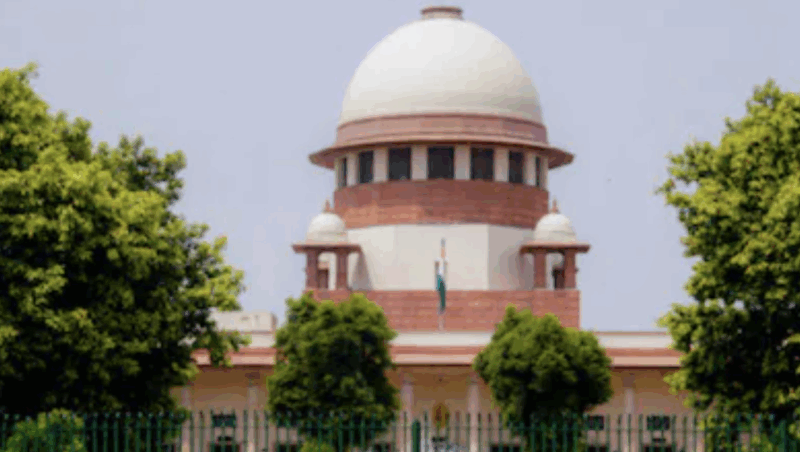
The Supreme Court on Wednesday raised sharp questions about the use of Aadhaar during the Election Commission’s ongoing Special Intensive Revision (SIR), and asked if a foreigner who has still managed to obtain an Aadhaar card and receive welfare benefits should be allowed to vote.
The issue came up even though the court had earlier directed that Aadhaar card can be added as the “12th document” in the Bihar SIR process. Chief Justice of India Surya Kant asked senior advocate Kapil Sibal, appearing for petitioners, if Aadhaar alone could become an automatic route to voting rights.
“Aadhaar is the creation of a statute. Nobody can dispute the use of Aadhaar card to avail welfare benefits… but does it mean that since he has got Aadhaar, he should be made a voter also?” the CJI asked.
This came after Sibal began arguing challenging the legality of the SIR exercise being carried out by the Election Commission of India (ECI). He said that such concerns might apply to border States but could not applied uniformnly to States like Kerala and Bihar.
The second phase of the SIR covers 51 crore people across 12 States and Union Territories.
Justice Joymalya Bagchi pointed out that the ECI has the authority to verify entries in the voter list, especially when those entries appear doubtful. He said enumeration forms were part of this verification process, and the Commission could not operate like an “inert post office”.
Sibal argued that the process itself was exclusionary. He also warned that millions of illiterate women could be at risk of being left out of the voter list simply because they might struggle to fill out the enumeration forms.
“Any exclusionary step or attempt taken by the EC is against the constitutional scheme… Any exclusion of a name from the electoral roll must follow a reasonable process,” he said.
He also questioned the powers given to booth-level officers (BLOs), who, under the SIR notification, were allowed to effectively decide whether a person was a citizen.
According to the petitioners, the SIR had turned into a form of “citizenship screening”, placing the burden of proof on existing voters.
Justice Bagchi noted that the ECI’s authority to examine documents flows from Section 21 of the Representation of the People Act and Article 326 of the Constitution, which clearly requires voters to be citizens. He said there was always some residual power available to a constitutional authority to conduct a preliminary enquiry.
Sibal clarified that he was not questioning the ECI’s jurisdiction, only what he described as an “unreasonable” and rushed process. He said there was no justification for completing the SIR within two months.
Chief Justice Kant, however, observed that the court could not stop the process simply because of doubts about time limitations. He said that the Bihar SIR had shown that the fears of mass exclusion did not materialise. Only a little over three lakh names were removed, and very few objections were raised.



