During Vladimir Putin’s high-security visit to Delhi, Prime Minister Modi presented the Russian president with a Gita translated into Russian, a symbolic cultural gift reinforcing long-standing ties. Former envoy Rajiv Bhatia called the trip crucial.
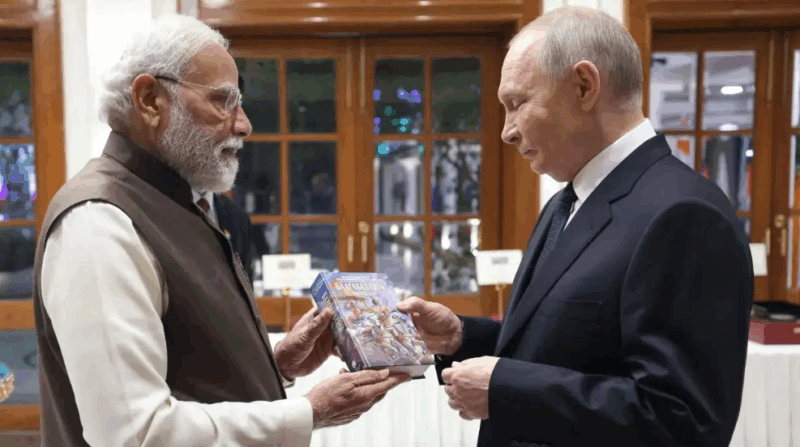
Photo : AP
Prime Minister Narendra Modi chose a distinctly civilizational touch for his engagement with Russian President Vladimir Putin, gifting him a copy of the Bhagavad Gita rendered in Russian. Officials and analysts see the choice as a nod to India’s soft-power tradition—using scripture and culture to signal friendship beyond hard security and energy deals. The meeting comes as New Delhi balances its historic Moscow ties with closer links to Washington and the West, especially under the shadow of the Ukraine war.
In an interview ahead of talks, Putin underlined that Moscow and New Delhi do not frame their cooperation as part of any anti-Western bloc. “Neither me nor Prime Minister Modi, despite certain external pressure we face, have never approached our collaboration to work against someone,” he said, arguing the partnership rests on mutual interests rather than confrontation. He also took aim at the G7’s “Big Seven” image, asking what was “so big” about them when India ranks third globally by purchasing power parity while the UK lingers around 10th place.
Presented a copy of the Gita in Russian to President Putin. The teachings of the Gita give inspiration to millions across the world.@KremlinRussia_E pic.twitter.com/D2zczJXkU2
— Narendra Modi (@narendramodi) December 4, 2025
Delhi Traffic Curbs as Summit Security Tightens
On the ground, Delhi Traffic Police rolled out a sweeping advisory for Friday, flagging diversions and rolling closures across central Delhi from 9 a.m. to noon due to “administrative exigencies” tied to the high-profile visit. Commuters were urged to avoid corridors such as W Point, A Point, ITO, BSZ Marg, Delhi Gate, JLN Marg, Rajghat and Shanti Van Crossings, Hanuman Setu–Y Point, Netaji Subhash Marg, Saleem Garh bypass and the stretch from Pragati Maidan Tunnel to Hanuman Setu, among others. Authorities said security and route sanitisation for Putin’s convoy were the main drivers of the restrictions.
The summit unfolds amid tightened anti-drone measures, layered police and paramilitary deployments and coordination between Indian agencies and Putin’s own security detail. Officials expect intermittent delays near government complexes, with advice for office-goers to use metro services where possible during the peak security window.
Why the Visit Matters, Beyond the Optics
Former diplomat Rajiv Bhatia called Putin’s India trip “a very important visit,” pointing to its timing as the first by the Russian leader since the Ukraine invasion and since visible strains in India–US ties. He noted it also follows India’s prominent role at recent G20 meetings, suggesting multiple strategic layers—from defence and energy deals to rupee–ruble trade mechanisms and sanctions navigation. “First of all, the focus will be on bilateral relations and how to deepen and strengthen this relationship… I think the limelight will be on the economic dimensions,” Bhatia observed, capturing the underlying agenda behind the warm optics and cultural gifting.



