As torrential rains trigger floods and landslides across Himachal Pradesh and the North East, the Indian Army has launched massive relief and rescue operations, emerging as the nation’s first responder in the crisis.
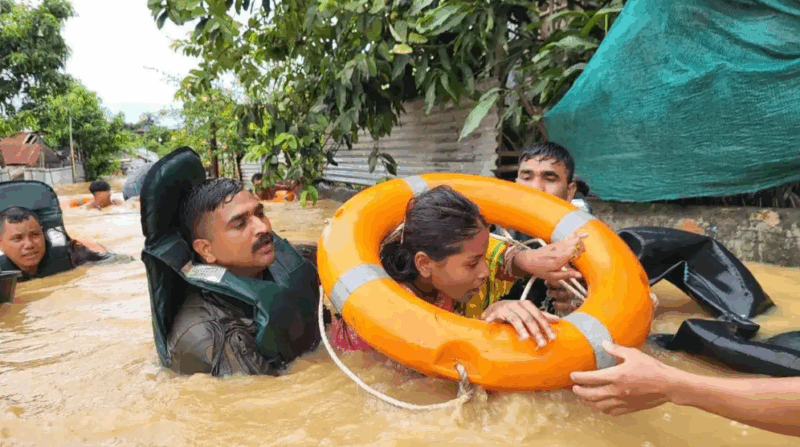
As relentless monsoon rains continue to batter parts of Himachal Pradesh and the North Eastern states, the Indian Army has stepped up as the nation’s first responder, launching large-scale relief and rescue operations across multiple disaster-hit zones. From the flood-ravaged villages of Mandi district in Himachal to submerged localities in Nagaland, Assam and Manipur, Army columns are working day and night to deliver critical humanitarian aid and ensure no one is left behind.
In Himachal Pradesh, the Army has mobilised relief teams in the worst-affected areas of Mandi district, where landslides and flash floods have cut off entire villages. Army columns are currently active in Thunag, Bagsiad, and Pandoh, coordinating closely with the State Disaster Response Force (SDRF), National Disaster Response Force (NDRF), and local authorities. On July 6, a vital mule track between Bagsiad and Thunag—essential for reaching stranded communities—was successfully cleared by Army personnel. This has enabled the steady delivery of food, medical aid, and relief kits to families in need.
Medical assistance camps have been set up in Thunag, where Army medical teams are providing first aid and essential healthcare services to affected locals. Relief materials are also being distributed to remote villages such as Degi, Rushad, and Chapad, which had remained inaccessible for days following the disaster. Aid reached Degi on July 7, Rushad on July 8, and Chapad on July 9, marking significant milestones in the outreach effort.
Communication remains a challenge in some of these remote pockets, especially in Thunag, where mobile networks are weak or absent. To ensure operational coordination is not disrupted, the Army has deployed high-reliability satellite communication systems, including ISAT phones and HX terminals, enabling real-time updates and rapid coordination with civil authorities.
In a major development today, the Chief Minister of Himachal Pradesh is scheduled to visit Thunag to personally assess the situation and interact with relief workers and affected families. Simultaneously, the Brigade Commander leading Army operations in the region will visit Mandi to review the ground situation, meet with relief teams, and hold strategic discussions with the Chief Minister and Deputy Commissioner to further streamline relief efforts.
Meanwhile, in India’s North East, the Army has activated ‘Operation Jal Rahat 2’ following widespread flooding caused by heavy rains. The operation is being spearheaded by Headquarters Inspector General Assam Rifles (North), with coordinated deployment in Nagaland, Assam, and Manipur. In Dimapur, Nagaland, the Deputy Commissioner formally requisitioned Army assistance on July 10 after floods inundated Singrijan Colony, one of the worst-hit areas. The Army promptly deployed an Engineer Task Force, which began relief work immediately. Although a verbal de-requisition was later communicated by civil authorities, Army teams remain on high alert, with resources fully mobilised and on standby.
In Assam’s Golaghat district, the Dhansiri River breached its danger mark earlier this week, prompting heightened vigilance. Although water levels are now slowly receding, the Army continues to monitor the situation closely and is prepared to launch rescue operations at short notice. In Manipur, rising water levels in the Nambol River have impacted several parts of Imphal West and Bishnupur districts. Army relief teams have been working in close coordination with local officials to evacuate affected residents and provide medical assistance and food supplies.
As of July 10, the Army has deployed 40 relief columns across the North East—24 primary columns and 16 in reserve. These teams have already rescued over 3,820 individuals, distributed more than 1,361 food packets, delivered medical assistance to over 2,000 people, and supplied nearly 15,500 bottles of drinking water.
In both Himachal and the North East, the Indian Army’s efforts have proven vital in preventing further loss of life and bringing relief to thousands. The swift deployment, logistical coordination, and unwavering commitment shown by the Army reflect its indispensable role not only as the nation’s military force but also as a pillar of humanitarian support during natural disasters.



