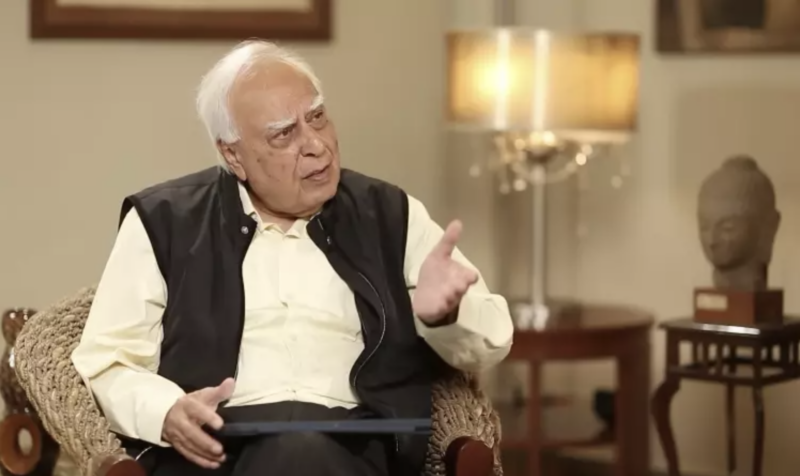
Senior Advocate Kapil Sibal recently said that the NCERT’s chapter on ‘corruption in the judiciary’ was a case of selective targeting of the judiciary as an institution. He added that while teaching young minds about societal corruption is required, highlighting corruption only within the judiciary would make them believe that justice is compromised.
At the same time, Sibal said that the judges are responsible for this sort of narrative as they have failed to perform their duties consistent with constitutional morality.
He said: “You saw that chapter in a class 8th book. Now, there is no gainsaying that there is corruption in the judiciary. There are some bad pennies everywhere in every institution, which spoils the name of the institution. So, we can’t sort of brush it aside under the carpet and say that look, there is no corruption. You can’t say that. There is corruption. But how is it that it has suddently founds its place in a class 8th textbook? I ask myself this question: would it have found place in class 8th textbook had the judges performed their duties consistent with constitutional morality. When you reach a certain level that public start believing that by and large the institution is corrupt, then you will have this narrative in a class 8th textbook. According to me, the judges have brought it upon themselves.”
You selectively only target the judiciary and teach minds, 13-14 years old, to grow in an environment where they feel that when they have to go to the Court, they believe the judge is corrupt. We know that the political system is far more corrupt. We know that the investigating agency is far more corrupt. We know that politicians are far more corrupt. We know the kind of constitutional immorality which actually runs through every political decision-making that takes place in this country. We know how Bills are passed, we know how Bills that have nothing to do with finance are smuggled in…You are teaching young children that these people are intellectually dishonest and otherwise corrupt. You don’t mention the politician, the minister, the system, agency or bureaucracy. Your intent is to intimate the judiciary. Your intent is to further damage the institution then you can capture it fully.”
Sibal was speaking at the Justice Unplugged 2026 organised by The Hindu in association with the VIT School of Law. He was speaking on the issue of ‘Constitutional Morality and the Supreme Court of India: Has the Court Moved from Constitutionalism to Pragmatism?’ in conversation with M Ram, Director of The Hindu Group.
He added that the chapter had been put in a proper context, also mentioning societal corruption in general, which would not have been an issue.
“NCERT will never put it there. But because they were acting on the government, the government must have told them to put it there so that we can actually tell the judges that see, that is what the children think about it. I am very happy that the Chief Justice to take up the issue and do what he did,” he remarked.
When Ram asked if the order was overreaching in terms of the fact that it ordered a complete ban on its distribution, Sibal justified that it was the right thing to do. In a suo motu case registered against the NCERT officials, the Supreme Court last week observed that it was an attempt of deliberate act to scandalise the judiciary. It ordered a complete seizure of all hard copies and take down of soft copies.
“They[children] have to grow up as citizens who are imbued with the sense of purpose, vision, who have a dream. If they become adults with the thought that judiciary is corrupt, where are we going to reach as a society? ” Sibal questioned.
Constitutional morality eroding from spaces
Sibal was asked by Ram as to where we as a nation stand on constitutional morality.
Sibal replied that while constitutional morality is a dynamic concept, the beauty of the Constitution is that it gives power to the Courts to interpret it with the changing times. It is doing justice without fear or favour. But what is being witnessed today is a complete breakdown of constitutional morality.
He said that the Supreme Court is being confronted with matters concerning alleged hate/communal speeches by public functionaries or the frequent arrest of student leaders who are protesting. But instead of dealing with issues, it continues to relegate matters to the High Courts.



