Mold lurking behind walls and under floors can sicken families for months before anyone realizes what’s wrong. Traditional mold testing requires swabbing surfaces, sending samples to labs, and waiting three to seven days for results, all while potentially harmful spores continue circulating through living spaces. Researchers at Germany’s Karlsruhe Institute of Technology have created an electronic “nose” that measures air samples in about 30 minutes and identifies toxic mold species with performance levels approaching laboratory-grade testing in controlled conditions.
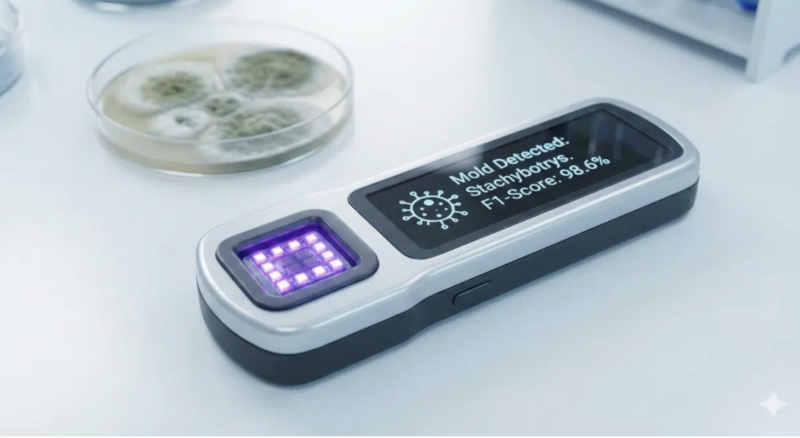
The device works similarly to mold-detection dogs but eliminates the need for expensive animal training and provides something dogs cannot: precise identification of mold species. Published in Advanced Sensor Research, the study shows that sensor technology can distinguish between Stachybotrys chartarum and Chaetomium globosum, two of the most common and concerning molds found in water-damaged buildings. Both species thrive on moisture-compromised materials like drywall and wallpaper, producing metabolites linked to irritant and inflammatory responses in humans.
Indoor mold creates health and financial problems in many damp buildings. Current detection methods rely on visual inspection, air sampling, or surface swabs followed by laboratory culturing, a process that delays remediation efforts. While mold-detection dogs offer faster screening, their training is costly and time-intensive, and the animals can only signal mold presence without differentiating between species, a critical limitation when determining health risks and remediation strategies.
Electronic Nose Mold Detection Using Chemical Signatures
The innovative e-nose uses tin oxide nanowires as its sensing material. These microscopic wires change their electrical resistance when exposed to different volatile organic compounds, the chemical signatures that molds emit as metabolic byproducts. Each mold species gives off its own characteristic mix of gases that the sensor can recognize.
The device contains 16 individual sub-sensors, each coated with the same tin oxide nanowires but positioned to detect slight variations in the chemical signals. When ultraviolet light activates the nanowires, they become sensitive to gas molecules in the air. Mold compounds either directly oxidize or reduce the sensor surface, or they alter how oxygen interacts with it, changing the electrical resistance in measurable ways.
Researchers grew both mold species on two different substrates to simulate real-world variability: one substrate mixed agar with shredded gypsum board (mimicking drywall), while the other combined agar with wheat flour (representing paper and cellulose materials). Samples were incubated at 25 degrees Celsius with 60% humidity for at least 10 days until mold fully colonized the growth surface. The team conducted eight measurements for each mold species over two weeks. In their lab setup, each air sample was measured for about 30 minutes, and the system used that signal pattern to classify what it detected. The measurements generated about 324,000 data points through resampling.
Machine Learning Boosts Mold Detection Performance to 98.4%
The research team tested several approaches to classify the sensor data. Their initial method used conventional linear discriminant analysis, a statistical technique that finds patterns distinguishing different groups. This approach included seven categories: clean air, gypsum substrate alone, wheat substrate alone, and each mold species on each substrate type. Conventional analysis produced an F1-score of only 83.74%, with many samples overlapping. (Think of F1-score as a single report-card number that rewards both catching true mold signals and avoiding false alarms.)
The team then simplified the model by removing substrate dependency, merging samples into broader categories of Stachybotrys, Chaetomium, and “no mold.” When researchers created separate analysis systems for gypsum-based samples and wheat-based samples, the F1-score jumped to 92.64% for gypsum and 98.09% for wheat substrates.
The strongest results came from an ensemble approach combining multiple analysis models with a subsequent classification algorithm. This system creates numerous individual models, each trained on different subsets of the data, then synthesizes their predictions. The best-performing approach reached an average F1-score of 98.37% across all seven original categories, performance approaching laboratory-grade testing. To prevent false positives, the team implemented a majority voting system where the final prediction is only accepted if more than half of the individual models agree.
Translating Laboratory Success to Real Buildings
The study was conducted under controlled laboratory conditions, which differ substantially from occupied buildings. Real indoor environments contain numerous volatile compounds from building materials, cleaning products, cooking, and human activities that could interfere with mold detection. The researchers suggest that baseline measurements in mold-free areas of a building could allow mold detection using outlier analysis, flagging areas where chemical signatures deviate from the clean baseline.
The study focused on two mold species, but buildings commonly harbor others like Aspergillus and Penicillium. These also produce characteristic chemical signatures, suggesting the e-nose technology could expand to detect them. Additional research is needed to determine which species can be reliably identified individually versus which might be grouped into broader categories, and how well the sensors perform in actual buildings with naturally occurring mold contamination.
Source: https://studyfinds.org/electronic-nose-mold-detection/



