Lebanon’s government on Monday banned military activities by Hezbollah after it opened fire on Israel to avenge the killing of Iran’s supreme leader, a move likely to fuel tension with the Tehran-backed group as it faces a new Israeli offensive.
The government’s decision, which was rejected by a senior Hezbollah politician, underlined a dramatic shift in Lebanon’s power balance since the once-dominant group was pummelled by Israel during a war in 2024, reshaping politics in a country that suffered civil conflict from 1975-90.
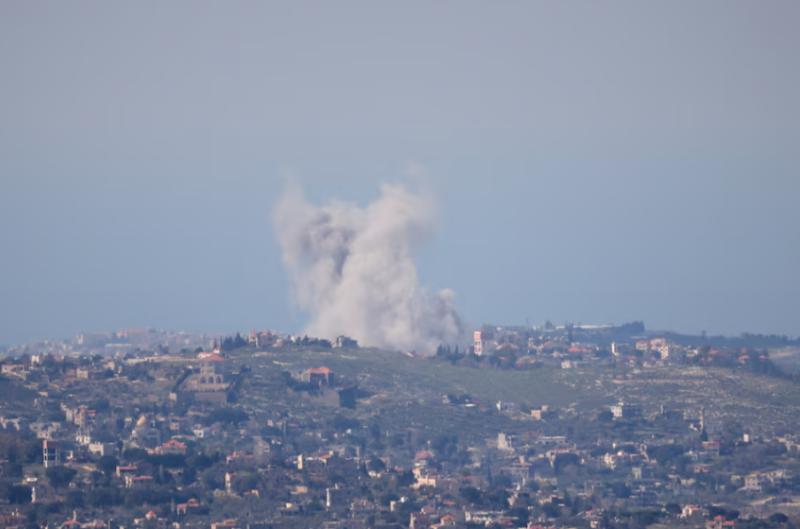
Israel launched heavy airstrikes on the Hezbollah-controlled southern suburbs of Beirut and more widely in Lebanon, in response to the Hezbollah drone and rocket strike, killing 52 people and wounding more than 150, according to a Lebanese health ministry official.
RESIDENTS FLEE, CLOGGING ROADS
Roads were jammed as people fled from targeted areas which bore the brunt of Israeli bombardment in 2024.
The violence widened the conflict that has spread through the Middle East since the United States and Israel attacked Iran on Saturday, prompting Iranian retaliatory strikes across the region.
Hezbollah, a Shi’ite Muslim group established by Iran’s Revolutionary Guards in 1982, said its attack was to avenge “the pure blood” of Iranian Supreme Leader Ayatollah Ali Khamenei, who was killed on Saturday, and “in defence of Lebanon”.
It was Hezbollah’s first attack since the 2024 war, despite near-daily Israeli strikes targeting the group.
Israel held Hezbollah responsible for the escalation and declared Hezbollah leader Naim Qassem a “target for elimination”. The Israeli military said it had killed Hussein Makled, a top Hezbollah intelligence official.
There was no confirmation from the group.
Israel said no injuries or damage were reported from Hezbollah’s attacks.
“We have launched an offensive campaign against Hezbollah … We must prepare for many prolonged days of combat ahead,” Israeli Chief of the General Staff Eyal Zamir said.
DISREGARD FOR THE ‘MAJORITY OF LEBANESE’
In a statement after a cabinet meeting, Prime Minister Nawaf Salam said Hezbollah’s attack showed disregard for “the will of the majority of Lebanese” and that Lebanon rejected being dragged into the regional conflict.
The state, he said, rejected any military actions launched from Lebanon “outside the framework of its legitimate institutions and affirmed that the decision of war and peace is exclusively in its hands”.
This “necessitates the immediate prohibition of all Hezbollah’s security and military activities as being outside the law, and obliging it to hand over its weapons to the Lebanese state”, he said.
Senior Hezbollah politician Mohammed Raad, in a written statement issued by the group, said there was no justification for the “government to take bold and confrontational measures against Lebanese citizens who reject occupation”.
In 2008, an attempt by the Lebanese government to outlaw Hezbollah’s military telecom network led to armed conflict, during which Hezbollah fighters took over parts of Beirut.
Paul Salem of the Middle East Institute think-tank said the decision was historic but implementing it would be challenging.
“A clash is possible, and maybe a clash here and there is necessary if the state is going to behave like a state and implement its laws,” he said.
“The state is not interested in confrontation – they are very aware of the risks, and they are not going to seek a broad confrontation – but this sends an important signal to Hezbollah that they have gone way beyond the pale,” he said.



