Germany has dismissed a US security strategy that was scathing in its assessment of Europe. Meanwhile, a new study says hundreds of children and teenagers were abused by clergy.
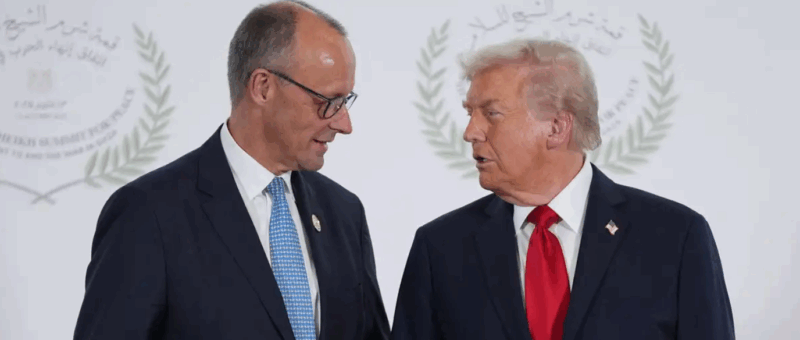
Merz rows back on migration comments that caused outrage
German Chancellor Friedrich Merz has pulled on comments he made last month on migration in Germany, when he said the interior ministry was working on large-scale deportations.
In an interview with public broadcaster ARD on Monday evening, he said Germany needed migration.
Explaining that there were “neglected” cities which required work, he added: “It’s two parts of the same answer. We need migration, we need immigration, the entire medical sector, the care sector, many other areas.”
“Without those who come from other countries, it simply doesn’t work any more,” Merz added.
However, he went on express that those who wish to live in Germany needed to adhere to rules of the country.
“If they don’t, they must leave,” Merz said.
130 Christmas trees stolen in Cottbus
Thieves in the eastern city of Cottbus made off with some 130 Christmas trees up for sale over the weekend, the second of the Advent period.
Police say the trees were worth more than €4,000 ($4,650) in all.
The theft was first noticed and reported on Monday morning.
Prices for Christmas trees, a highly popular adornment for German sitting rooms in the festive season, can range from around €12 to €30 depending on the type of tree.
The most expensive is the Caucasian fir, which is often favored for its attractive, glossy foliage, made up of needles that are flattened and not sharp and that tend to remain on the tree even when it dries out.
German intelligence chief warns of stepped-up Russian meddling in state elections
Germany’s domestic intelligence chief Sinan Selen has warned that Russia is likely to intensify disinformation efforts next year, particularly as several state elections approach.
Selen described “very strong interactions” between developments in Ukraine and the hybrid threats facing Europe, calling them “communicating vessels.” Understanding events in Ukraine, he said, was essential to gauging the threat scenarios Germany and Europe may face.
In his speech at the symposium “Turning point — what now? The role of the BfV in Germany’s security architecture”, Selen said Europe is being attacked “here and now: hybrid, virtual, analog.” Russia, he added, is “undoubtedly aggressive, offensive and escalatory” as a hybrid actor.
Speaking on the sidelines of the symposium, Selen told the AFP news agency that elections “always play a major role” in Russian influence operations. He said Moscow could feel “encouraged” to increase pressure on Europe as the war in Ukraine evolves. “Both factors must be closely monitored,” he said.
Hostile actors, he said, exploit public overstimulation through “alarmist and shrill messages” online to stoke fear.
Germany will hold five state elections next year: Baden-Württemberg and Rhineland-Palatinate in March, and Saxony-Anhalt, Berlin and Mecklenburg-Western Pomerania in September. Polls suggest the AfD could emerge as the strongest party in the two eastern state.
Survey finds Advent remains meaningful for most Germans
A large majority of Germans continue to see Advent as a meaningful part of the year, according to a new YouGov survey released for the Catholic KNA news agency.
The poll found that 81% attach special significance to the season, with 57% ranking decorations and candles as most important and 44% choosing Christmas markets.
About 43% placed baking cookies at the top of their list, while 41% highlighted opening an Advent calendar. Only 11% said church services or religious celebrations play a key role.
Nearly one-third still value retreat and reflection during Advent, with approval for this highest among those aged 45 to 54 at 35%. For 27%, music or singing is a central part of the season.
YouGov surveyed 15,649 adults in early December, allowing multiple responses. The results are representative of Germany’s population aged 18 and older.
Germany rejects Trump’s Europe attacks
The German government has rejected criticism of Europe contained in the new US national security strategy, saying it continues to view Russia as a threat to its security.
The strategy paper, published last week, criticized Europe for being over-regulated and at risk of “civilizational erasure” through immigration, while saying the US would be “cultivating resistance to Europe’s current trajectory within European nations.”
German government spokesman Sebastian Hille said Berlin rejected “the sometimes critical tone directed at the EU.”
“Political freedoms, including the right to freedom of expression, are among the fundamental values of the European Union,” he said. “We see accusations in this regard as ideology rather than strategy.”
Hille added that Germany disagreed with the analysis because it did not classify Russia as a threat.
“We do not share this assessment. We stand by NATO’s joint analysis, which holds that Russia poses a danger and a threat to transatlantic security.”
However, the spokesman added that Germany was keen to work with Washington within NATO and on issues relating to Ukraine.
“In view of the major security challenges we face, transatlantic cooperation is of central importance for our shared security, now and in the future,” he said.
Foreign Minister Johann Wadephul also pushed back against elements of the new US strategy on Friday.
Study finds hundreds of minors abused by clergy in Passau diocese
A new study has found that hundreds of children and teenagers in the Catholic Diocese of Passau were abused and mistreated by clergy over several decades.
At least 672 minors have been subjected to serious abuse by priests since 1945, according to findings released Monday by Marc von Knorring, head of the study.
Researchers identified 154 accused or convicted perpetrators at the Bavarian diocese. The three-year study was conducted by a team at the University of Passau. Bishop Stefan Oster called the findings a massive failure on the part of the Church.
Knorring said events had unfolded “that should never have happened,” adding that victims suffer the consequences for life. The study concludes that the 154 accused clergy were not solely to blame.
Certain patterns of thinking and behavior within the Church system itself, the researchers said, contributed to decisions in which “a number of bishops and vicars general, in numerous cases, placed the protection of the institution and the priesthood above the well-being of those affected.”
Report says Merz filed hundreds of insult complaints, prompting two home searches
Chancellor Friedrich Merz filed hundreds of criminal complaints for insult during his time as leader of the conservative CDU/CSU parliamentary group in the Bundestag,according to a media report.
In two cases, this was followed by police searches of the homes of the suspected authors, the Welt am Sonntag newspaper reported, citing documents such as lawyers’ letters and investigation files.
The insults in question on social media included terms such as “a**hole,” “filthy drunk,” and “little Nazi.” According to the report, the latter two expressions led to house searches, though in the case of “filthy drunk” a court later ruled the search unlawful.
The period in question was before Merz became the chancellor, at which point he ceased to be the parliamentary group leader.
In Germany, insulting a person can constitute a criminal offense under the criminal code, allowing authorities to investigate if the alleged victim files a complaint.
Merz’s parliamentary office “largely” confirmed the incidents, the report continued. According to the newspaper, the current Chancellor donated compensation payments and fines “in full to charitable causes in the Hochsauerland district,” where Merz’s constituency is located.
About a year ago, a house search following a criminal complaint by then-Economy Minister Robert Habeck of the Green Party sparked a public debate about proportionality.
That case involved an insult using the word “idiot.” The author was later sentenced to a fine, though not for the insult itself, but for a different post with a Nazi reference. The incident was taken up particularly in right-wing circles and triggered accusations of alleged state censorship.
Source : https://www.dw.com/en/germany-news-berlin-rejects-us-criticism-of-europe/live-75060190



