Rock climber Alex Honnold plans to scale the facade of what was once the world’s tallest building — live on Netflix. But not all are impressed by the idea.
“It should be within my comfort zone,” Alex Honnold said in on a recent edition of The Jay Shetty podcast. “So it’s not so much about ‘what if I die?'”
The 40-year-old American is one of the world’s best climbers, specifically rock and vertical climbing. Weather permitting, Honnold will be venturing onto unfamiliar terrain in Taiwan on Saturday morning (January 24), local time. He intends to climb the facade of the Taipei 101 skyscraper “free solo,” meaning alone and without any safety equipment.
Netflix, the world’s largest streaming service with more than 300 million subscribers, is planning to broadcast Honnold’s ascent live. In the trailer for the broadcast, Netflix plays on the life-threatening nature of the event.
“I think I’ve gotten used to fear over the years. It’s an ever-present part of climbing,” Honnold says in the trailer.
“No matter how much you prepare, occasionally things just happen. If you fall, you’re gonna die.”
Warning about possible copycats
The event is not without its critics, including Claudia Paganini, philosopher and theologian who lectures at the University of Innsbruck. One of her main areas of research is media ethics.
Paganini told DW that Netflix would be crossing a line with the broadcast, because of “the very concept and voyeuristic dynamics” that it promotes.
“I consider the live broadcast of a high-risk, potentially fatal event problematic because the media are no longer just documenting, commenting on, and contextualizing it, but are actively co-producing the event as a spectacle,” Paganini said.
She added that the risk is being deliberately used to increase attention and reach – and financial gain. Therefore, the responsibility “no longer lies primarily with the athlete, but with the media disseminating the information.”
Furthermore, Paganini warns that the live broadcast of Honnold’s ascent is “likely to normalize risky behavior and encourage imitation, even if one emphasizes that an exceptional athlete is involved.
“Therefore, the planned project must also be viewed very critically from the perspective of child and youth protection.”
Oscar for climbing documentary
Throughout his climbing career, Honnold has frequently walked a tightrope between life and death.
In 2017, he became the first person to climb the 900-meter-high granite wall of the legendary El Capitan in Yosemite National Park in the United States, without a rope. He completed the extremely challenging “Freerider” route in just four hours. The route had been first climbed in 1995 by Germany’s Alexander Huber.
The documentary “Free Solo” about Honnold’s ascent won an Oscar in 2019 and reached millions of viewers in cinemas and later via streaming services.
The film thrived on the thrill that the spectacular images from the wall triggered in viewers. But unlike the upcoming live broadcast from Taiwan, those viewers already knew that the climb had ended well.
‘Not relevant for climbers’
The climbing community appears not to be as excited about the event as one might think.
“The ascent of Taipei 101 won’t provide any new insights into climbing, so from that perspective, the stunt isn’t relevant for us as climbers,” Alexander Huber told DW.
“But of course, it will reach a very wide audience via Netflix, and Alex is certainly entitled to do it.”
Since his 2017 feat on El Capitan, Honnold has been among the top earners in the climbing world. The climber puts a third of his earnings into his own foundation. The Honnold Foundation supports private solar energy initiatives worldwide. How much Netflix is paying the climber for his latest project has not been disclosed.
Eight overhanging blocks
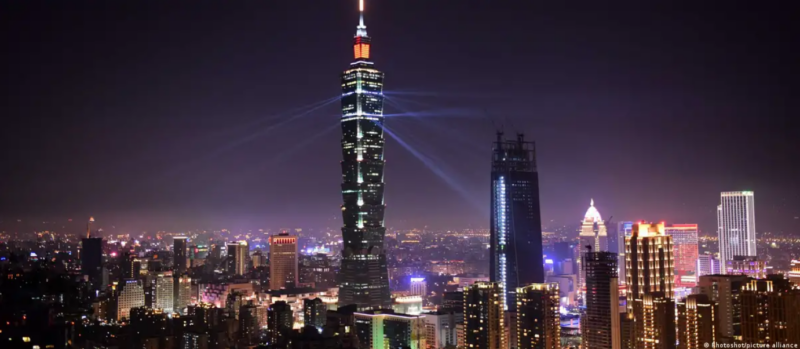
Taipei 101 – the number indicates the number of floors – was completed in 2004 and, at 508 meters, was then the tallest building in the world. Three years later, it was surpassed by the 828-meter-tall Burj Khalifa in Dubai.
The landmark of Taiwan’s capital city is reminiscent of a Chinese pagoda in its shape. Eight identically shaped blocks rise above a trapezoidal first section, overhanging upwards. The uppermost, narrower section of the building is crowned by an antenna array. The facade is made primarily of glass and aluminum.
‘He’ll do it very easily’
It’s not the first time someone has climbed the building. French free climber Alain Robert did it on Christmas Day 2004. Contrary to his usual practice, the “French Spiderman,” as he calls himself, was secured with a rope from above during his climb.
The Taiwanese government had hired him for this stunt to promote the then-new skyscraper. Over his career, Robert has scaled around 200 buildings worldwide via their facades, mostly free solo. While the Tapei climb was government approved, most were not and by his own account, Robert has been arrested more than 170 times for climbing buildings.
“The most important thing about Taipei 101 is not to lose concentration,” the now 63-year-old told Climbing magazine.
“What makes it complicated is to repeat the same move over and over again. But otherwise, you just take it one move at a time.”
After each of the eight blocks, Honnold can rest on a wide ledge before continuing his climb, Robert said.
“I’m sure he’ll do it very easily.”
Source : https://www.dw.com/en/free-solo-climb-on-netflix-if-you-fall-youre-gonna-die/a-75580558



