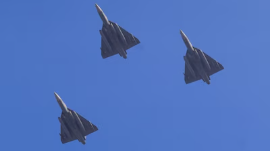
The Indian Air Force currently operates a variety of fighter jets, including the Russian-origin Su-30MKI, French Rafale, indigenous Tejas, Mirage 2000, and Jaguar
What will India’s fifth-generation fighter aircraft be? The speculation has been going for several months as the nation weighs its options amid a complex geopolitical landscape.
With its indigenous Advanced Medium Combat Aircraft (AMCA) still years away from operational readiness, expectations are turning towards potential acquisitions from foreign manufacturers. Only two viable contenders are practically available: the American F-35 Lightning II and Russia’s Su-57 Felon. Neither the Indian government nor defence analysts have signalled a clear preference.
Amid the recent developments between India and the US, reports suggest India has conveyed decision on the F-35 to the US. However, Minister of State for External Affairs, Kirti Vardhan Singh, recently clarified in Parliament that “no formal discussions have been held as yet on this issue” concerning the F-35. He referred to the India-US Joint Statement from February 2025, following Prime Minister Narendra Modi’s meeting with President Trump, in which the US agreed to “undertake a review of its policy on releasing fifth-generation fighters (such as the F-35) and undersea systems to India”. However, this was only a policy review, and no proposal or negotiation has been initiated between the two nations.
The offer from the United States to potentially supply F-35 fifth-generation stealth fighters has been a headline-grabbing development since its inception, but an analysis of India’s defence ecosystem, technical realities, and indigenous ambitions shows why this deal is unlikely to materialise soon.
Speaking on the current scenario, Dinakar Peri, Fellow, Security Studies at Carnegie India, said, “While the lack of a fifth generation fighter jet is going to be a glaring gap in the Indian Air Force (IAF), the choice of importing a FGFA in small numbers is a hard one to make. The indigenous AMCA is just taking off in terms of development and is about a decade away. Another interim buy may take resources and time away from the crucial programme.”
Why Not F35?
The Indian Air Force currently operates a variety of fighter jets, including the Russian-origin Su-30MKI, French Rafale, indigenous Tejas, Mirage 2000, and Jaguar. Over the past few years, India has created an ecosystem supporting these fighters, with advantages in desired integration, interoperability, availability of expert crew and maintenance facilities.
“When selecting an aircraft, it’s not just about acquiring a platform that can fly. You must consider its compatibility with your operational needs—whether it can integrate with existing systems, communicate effectively with other platforms, and support your current weapons and infrastructure. The F-35 introduces a completely new ecosystem with predominantly American systems, which may limit flexibility and pose challenges to the existing systems,” said a senior Indian Air Force fighter pilot, on condition of anonymity.
Peri said, “The F-35 is the cutting edge of stealth and military aviation. However, that necessarily doesn’t mean it is the best bet for India for a variety of reasons. India doesn’t have the US fighter ecosystem and going through the curve will take long.”
“A more pertinent aspect is how much the US wants the F35 to be integrated into India’s military ecosystem which has high-end Russian systems such as SU-30MKIs, S-400 air defence systems, in addition to French and Israeli system, among others. Without seamless integration, the F35 cannot become an effective platform that it’s envisaged to be, nor can the aircraft itself be fully exploited to its potential,” he added.
Su-57 As An Option
Many consider the Russian Su-57 a viable option given the circumstances surrounding the F-35. However, this option comes with its own challenges. Along with the fear of sanctions and political pressure, there are sufficient reasons to believe that deliveries will be delayed, and the jet may not fully serve its intended purpose.
While the Su-57 offers benefits such as technology transfer and easier integration, given India’s existing Russian aircraft ecosystem, its issues—delayed production, sanctions risks, past technological concerns, payment hurdles, and alignment complexities— bring challenges.
Wait For AMCA
Following Defence Minister Rajnath Singh’s approval, public and private sector companies can collaborate to execute India’s Advanced Medium Combat Aircraft (AMCA) programme. While development is progressing rapidly, the prototype is not expected before 2027-28. DRDO officials have indicated that the aircraft’s induction will likely occur no earlier than 2036. This timeline exacerbates the existing shortage of fighter jets in the Indian Air Force. Consequently, experts suggest inducting 4th Generation Plus (4Gen+) aircraft to bridge the gap until the AMCA is operational.



