Elon Musk’s SpaceX successfully launched the 11th test flight of its Starship megarocket, which is part of the tech mogul’s ambitious vision to take humans to Mars.
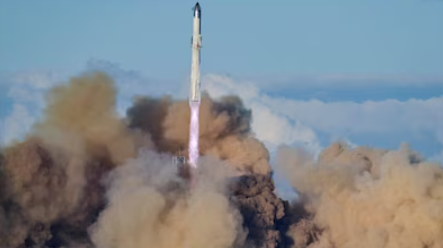
Elon Musk’s SpaceX successfully launched the 11th test flight of its Starship megarocket, in a mission aimed for the rocket to travel halfway around the world before dropping into the Gulf of Mexico.
SpaceX planned to use Starship, the world’s largest and most powerful rocket, in its efforts to return astronauts to the Moon. The company also tried to defy critics who said its technology may not be enough to deliver NASA’s lunar projects, and also to fulfil Musk’s vision to take humans to Mars.
In its 11th test voyage, the enormous rocket took off Monday from SpaceX’s south Texas launch facilities just after 6:25 pm local time (2325 GMT), according to a live video feed. This test flight carried eight mock Starlink satellites. During the mission, SpaceX deployed its second cluster of dummy Starlink satellites in space.
The booster made a controlled entry into the Gulf of Mexico as planned, with the spacecraft skimming space before descending into the Indian Ocean. Nothing was recovered from the site.
“Hey, welcome back to Earth, Starship,” said SpaceX’s Dan Huot as other employees cheered on. “What a day.”
Why Is This Mission Important?
The latest Starship test flight assumes significance as it demonstrates the giant 403-foot vehicle’s design for carrying satellites and eventually taking humans to the moon and Mars.
Its last mission in August came as a success after a string of failures this year that raised concerns that Starship may not be able to carry astronauts to the Moon by the end of this decade as part of NASA’s Artemis programme.
Starship has successfully deployed our @Starlink simulators pic.twitter.com/muNMalZkbT
— SpaceX (@SpaceX) October 13, 2025
The manned Artemis III mission is intended for mid-2027, but a NASA safety advisory panel has warned it could be “years late,” according to Space Policy Online, amid a rival effort from China that is gunning for its first crewed mission by 2030.
Previous Starship test flights have ended in failures, with explosions of the upper stage, including twice over the Caribbean and once after reaching space. However, SpaceX managed to deploy eight dummy Starlink internet satellites during August’s successful flight.



