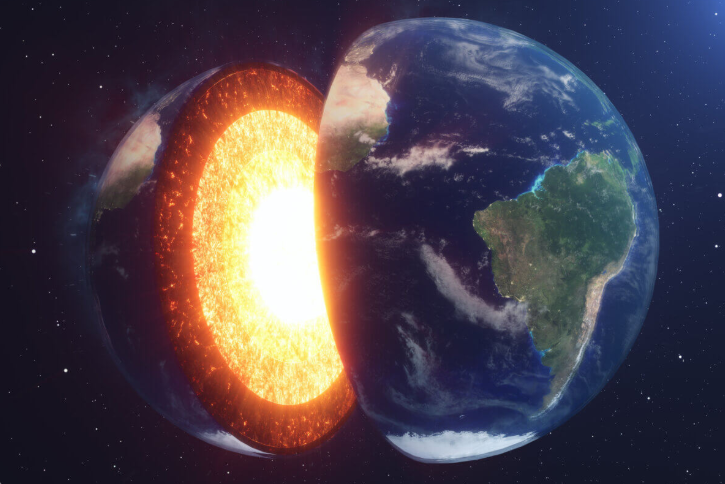
Deep beneath the surface of our planet lies the Earth’s core, a solid ball of iron under crushing pressure. Now, however, scientists conducting laboratory experiments have found evidence suggesting it may not be a uniform sphere after all.
Instead, lab tests on iron mixed with silicon and carbon show properties consistent with a layered structure, with different chemical compositions at different depths. If correct, this hidden structure would have formed as the core crystallized from the center outward, naturally sorting lightweight elements toward the outer layers while leaving the center more iron-rich.
The work addresses a puzzle that has bothered geophysicists for decades. When earthquake waves travel through the inner core, they move at different speeds depending on which direction they’re headed, a property called anisotropy. Stranger still, this effect isn’t uniform. The outer portions of the inner core show weak anisotropy while the central region shows much stronger anisotropy. A compelling explanation has been difficult to pin down – until now.
A research team at the University of Münster in Germany may have found an answer by recreating inner core conditions in their lab. They squeezed iron mixed with small amounts of silicon and carbon (proportions scientists think may match the actual core) to crushing pressures in a diamond vise while heating it to extreme temperatures. When they measured how this material would affect seismic waves, something clicked: the silicon-carbon mixture showed low anisotropy, roughly consistent with what seismologists infer for the outer portion of the inner core. Pure iron, by contrast, showed high anisotropy matching observations from the center.
The results, published in Nature Communications, suggest Earth’s core could be chemically stratified rather than uniform.
How Freezing Iron Could Have Created Layers
The core didn’t start out solid. As Earth cooled over geological time, conditions at the center eventually allowed iron to begin crystallizing despite the crushing pressure. That process continues today, with the boundary between solid inner core and liquid outer core slowly advancing outward.
Crucially, as molten iron freezes onto the growing inner core, silicon and carbon get incorporated at levels that depend on temperature and pressure. Studies of iron alloys show that cooler temperatures and lower pressures both favor more silicon and carbon dissolving into solid iron. Since pressure drops as you move from center to edge, each successive layer that crystallized could have incorporated progressively more of these lightweight elements.
Think of it like making rock candy. As sugar solution slowly crystallizes, different conditions at different times can create layers with slightly different properties. Except this is 800 miles across, made of iron instead of sugar, and formed over vast stretches of geological time. If the model is correct, the oldest, most iron-rich material sits at the center while younger, more silicon-and-carbon-rich material forms the outer layers.
Squeezing Samples to Extreme Pressures
The team couldn’t drill to the core, obviously. Instead, they brought approximations of core conditions to a lab in Germany using diamond anvil cells, which are devices that squeeze microscopic samples between two diamonds to create enormous pressures. They also heated the samples with electrical resistance.
The experiments hit pressures up to 128 gigapascals and temperatures up to 1,100 Kelvin. That’s not quite as extreme as the actual inner core, which experiences roughly three times more pressure and much higher temperatures; but close enough to help constrain models that project the behavior to true core conditions.
Powerful X-rays from a synchrotron facility revealed how the samples’ crystal structure deformed under stress. When iron is squeezed in one direction, the atomic layers can shift and align. This alignment controls how seismic waves travel through the material. By measuring the alignment in their tiny samples, the researchers could predict what earthquake waves might experience passing through a planetary volume of the same material.
Silicon and Carbon Change the Picture
The key finding: pure iron and the silicon-carbon alloy behave quite differently. Pure iron squeezed and heated to conditions approaching the core’s develops strong alignment that can make seismic waves travel several percent faster in one direction than another, often on the order of 6-7% in models. The iron-silicon-carbon mixture? Closer to 2%.
That’s consistent with what seismologists observe. The outer portion of the inner core shows roughly 2% anisotropy. The central region shows higher values, around 4-6%. If silicon and carbon concentrations increase toward the edge, as the crystallization process would predict, the seismic observations align with the laboratory findings.
The research also revealed that adding carbon strengthens the iron alloy significantly, making it more resistant to deformation. This affects how the material could develop its aligned structure over geological time as the core continues to evolve.
Why This Matters Beyond Cool Science
More broadly, because the core helps power Earth’s magnetic field through churning motions in the liquid outer core, understanding the solid inner core’s structure matters for modeling how this magnetic shield works. The field protects Earth’s surface from harmful solar radiation and has helped maintain habitable conditions over geological history.
Chemical layers in the solid inner core could influence heat flow and interactions at the boundary with the liquid outer core, potentially affecting the magnetic field’s pattern and stability. Knowing the inner core may have stratified structure helps scientists build better models of these deep Earth processes.
Source : https://studyfinds.org/earths-core-may-have-an-onion-like-structure/



