While the NDA put up its best performance since 2010 in Bihar, the Mahagathbandhan saw its worst.
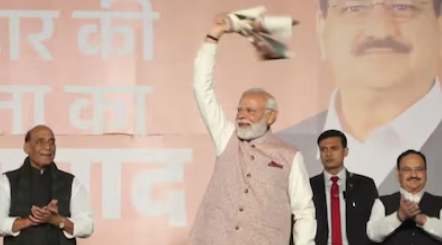
It is a decisive verdict in Bihar. So decisive that it has proven all political pundits wrong in their estimates of the margins of an NDA victory.
With 202 seats, the NDA has decimated the opposition, putting up its best performance since 2010 — and Nitish Kumar will be back as the Chief Minister for the tenth time.
But how did this happen? What went so wrong for Mahagathbandhan in this crushing defeat?
Let’s decode all this and much more.
BJP won 89 seats out of the 101 it contested — an 88 per cent strike rate. 85 seats for the JDU which also contested 101 seats – an 84 per cent strike rate. JDU has almost doubled its seat tally from the last assembly elections when it had shrunk to 43. CM Nitish Kumar has made a loud statement.
But look at the decimation on the other side.
From being the single largest party in 2020 with 75 seats, the RJD has crashed to just 25 seats. The strike rate of Tejashwi Yadav is just 17 per cent since the RJD contested the maximum seats among all major parties — at 143.
The Congress has performed worse — winning just 6 seats out of the 61 it contested. A poor strike rate of 10 per cent. This is the worst performance of both the RJD and Congress since 2010 in Bihar.
RJD still has the largest vote share with 1.15 crore votes, while the BJP got 1 crore votes, the JDU got 97 lakh votes and the Congress got 44 lakh votes.
But in the complex alliance maths of Bihar, the translation into seats was decisive with the opposition reduced to just 35 seats and the ruling Bihar alliance notching up 202 seats.
There were two big flop shows. Prashant Kishor’s Jan Suraaj Party did not win even a single seat. Mukesh Sahni’s VIP also won nothing. Clearly, they both were overrated.
Let’s break down the exact issues that surged the NDA ahead — and the issues that pulled the Mahagathbandhan back. No rhetoric, no noise — just the clear takeaways from the ground.
WHAT WORKED FOR THE NDA
Number 1. The Rs 10,000 Scheme for 1.3 Crore Women: Nitish Kumar’s Rs 10,000 assistance for women became one of the most decisive factors. For many women voters, this wasn’t just a cash transfer — it felt like economic security and continuity of Nitish’s welfare-first approach. This created a strong and loyal women’s vote bank for the NDA.
Number 2: PM Modi’s “Katta and Jungleraaj” Messaging: Modi’s campaign hit hard on law and order. His repeated warnings about “katta” and a return of “jungleraaj” struck a chord — especially with first-time voters, women and urban voters. It revived old memories and framed the NDA as the safer choice.
Number 3. The Free Electricity Scheme: The promise of free power for all domestic consumers cut across caste and class lines. Electricity is universal — and this scheme helped NDA tap into lower-income households and rural families who saw immediate benefit.
Number 4. Nitish Kumar’s Personal Image: Despite political flip-flops, Nitish still retains credibility in Bihar. His governance record, women-centric schemes, prohibition, and administrative style gave NDA a trusted face. In tight contests, this personal goodwill mattered.
Number 5. Development Backed by the Centre: Roads, expressways, bridges, rail work, central schemes, and overall infrastructure support helped the NDA project a development-plus-stability narrative. Many voters felt the NDA ensured progress and continuity — not disruption.
NOW, WHAT DID NOT WORK FOR THE MGB
Number 1. The Shadow of Jungleraaj: The old image of lawlessness associated with RJD refused to fade. Even though Tejashwi campaigned on jobs and development, the legacy image stuck — hurting MGB’s credibility.
Number 2. Yadav Vote Leakage: For the first time in years, a section of the core Yadav vote shifted away from the RJD. Reasons varied: local dissatisfaction, Nitish’s credibility among older Yadavs, and BJP’s outreach strategies.
Even a small leakage was enough to damage the MGB in close seats. Muslim votes also seemed to have slipped away in Seemanchal where Asaduddin Owaisi’s Party has won 5 seats.
Number 3. The Unrealistic Job Promise: Tejashwi’s massive job guarantee generated enthusiasm, but ground voters doubted its feasibility. Many saw it as a political promise, not a practical plan — reducing its impact on final voting.
Number 4. Weak Congress Performance on 61 Seats: Congress held 61 seats, but its strike rate was poor. The party failed to mobilise voters or strengthen the cadre, dragging the alliance overall. This seat distribution proved costly for MGB.
Number 5. The “SIR” Controversy Became a Non-Issue: What the Opposition thought would become a major election flashpoint ended up having zero traction. Voters didn’t see it as a priority, and the issue faded — wasting valuable campaign time for the MGB, courtesy of Rahul Gandhi.
In short, the NDA’s mix of welfare, women-focused schemes, strong messaging, and Nitish’s goodwill created a winning coalition.
The MGB, despite high-energy rallies and big crowds, couldn’t overcome old perceptions, weak allies, and messaging misfires.
X-FACTORS
There are two more X-Factors in this election, which have a link from the past.
First, Bihar Poll Results Are Proof That Rahul Gandhi’s Chor Or Chori Claims Can’t Steal Modi’s Thunder.
It was ‘Chowkidar Chor Hai’ campaign in the 2019 Lok Sabha elections. And it was ‘Vote Chori’ in 2025 Bihar elections. Both slogans were the brainchild of Rahul Gandhi. And both have led to spectacular poll losses.
This will be some food for thought for the Congress party over how it is tackling the Modi-led BJP. Prime Minister Narendra Modi has predicted that the Congress could split in the future.
People resoundingly rejected Rahul’s charge against Narendra Modi in 2019 with a massive win for the NDA in the Centre. And in Bihar, people have again rejected the charge of Rahul Gandhi that votes were being stolen by the BJP. The ‘chori’ campaign of Rahul Gandhi has no takers, with his party reduced to just 6 seats in Bihar.
The other X factor is maybe the guilt of 2024 elections leading to massive voting in favour of PM Modi.
It is a well-known anecdotal and psephological fact that people of India felt a sense of guilt after 2024 Lok Sabha polls when BJP got just 240 seats. As a result, they have voted decisively after the Lok Sabha elections in favour of BJP: Haryana, Maharashtra, Delhi and now Bihar.
Remember the evening of 4th June 2024 at the BJP Headquarters. Modi came to address BJP workers after the NDA returned to power for the third successive time. However, the mood was not euphoric. The fact that the BJP finished at 240 seats was not lost on anyone. The image of a disappointed Narendra Modi travelled to every corner of India.
It was maybe then when the people of India instantly felt — that they had wronged a man like Modi. And that they will not fail to support Modi whole-heartedly.
What happened next? BJP returned to power in Haryana.
The NDA swept Maharashtra and the BJP won 132 seats.
Then came Delhi, where the BJP won for the first time in three decades.
And now, came the Bihar tsunami.
This is a strong message from the country’s people in supporting Modi.
This also shows up in the fact that the total number of seats won by the Congress in the six assembly elections since 2024 is less than the number of seats won by the BJP in Bihar alone. The Prime Minister also mentioned this on Friday. While the BJP won 89 seats in Bihar, the Congress has won just 80 seats together in the last six elections including Bihar! People have firmly rejected the Congress since 2024.



