After a Chinese navy destroyer and coast guard vessel collided during an attempt to disrupt a Philippine resupply mission, both sides will likely dig their heels in and heat things up, says S Rajaratnam School of International Studies’ Collin Koh.
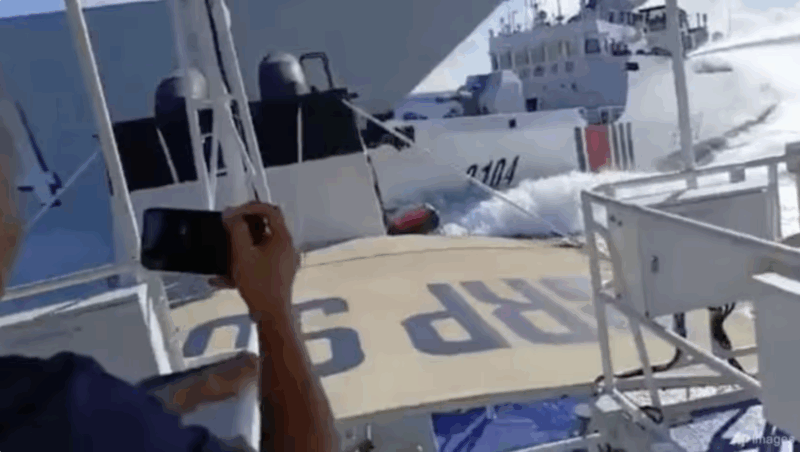
A seemingly standard, rather simple operation to foil a Philippine resupply run in the South China Sea on Aug 11 didn’t work out the way China would have expected.
The Philippine Coast Guard went about its routine Kadiwa mission to bring supplies to Filipino fisherfolk operating around the contested Scarborough Shoal, as a way of asserting the country’s sovereign rights in its exclusive economic zone. Beijing has exercised de facto control of the atoll since the standoff with Manila in April 2012, despite a 2016 ruling by an international arbitral tribunal in the Philippines’ favour.
But in a possible pincer move to expel the PCG vessel Suluan, the China Coast Guard cutter CCG3104 crashed headlong into the Chinese Type-052DL destroyer Guilin.
The navy destroyer was likely expected to adopt a blocking position right ahead of the Filipino ship to compel it to swerve, but might have been outmanoeuvred by the Suluan. Instead, the 7,500-tonne Guilin cut right behind the Suluan, while CCG3104 was still in hot pursuit.
The Chinese coast guard vessel’s bow appeared to be completely crushed by the impact, based on footage released by the Philippines. Whether there were casualties is still unknown, though maritime security expert Ray Powell posted on X that Chinese forces were conducting search-and-rescue operations at the site of the incident the day after, implying that there could have been Chinese personnel thrown overboard during the collision.
That notwithstanding, the Chinese coastguard statement and Ministry of Foreign Affairs’ regular press briefing on Aug 11 made no mention about the catastrophic collision. Direct comments came only four days later on Aug 15, criticising the Philippine vessels for “dangerous manoeuvring” but stopped short of confirming if any collision occurred.
BATTLE OF NARRATIVES
Beijing’s narrative has banged on the same old tiresome boilerplate: The Chinese forces conducted their operations to drive illegal vessels away in a “professional, standard, and lawful manner”.
If anything, this narrative was demolished by Manila’s timely public release of information about the collision, along with the video footage, even before the first statements transpired from Beijing.
This was part and parcel of the Philippines’ assertive transparency strategy adopted since February 2023, aimed at calling out Chinese coercive behaviour in the West Philippine Sea – what it calls the portion of the South China Sea it claims.
This strategy also allowed the Philippines to demonstrate the Suluan crew’s astute seamanship and even humanitarian spirit by offering help to their distressed Chinese counterparts, especially when contrasted with the fratricidal collision that appears to reflect poor seamanship.
And to top it off, Manila was able to show the world that Chinese forces’ dangerous and unprofessional actions at sea pose not only a danger to Filipinos but also to themselves.
Considering all these, Aug 11 marks a watershed for Manila’s efforts to assert its sovereign rights in the spirit of the 2016 South China Sea arbitral award. Though most resupply missions have been successful in the past, this Kadiwa mission’s success was significant given the more active role of the Chinese navy compared to the usual disruptions by the coast guard.
EXPECT WATERS TO HEAT UP
After this unprecedented and hugely embarrassing collision, Beijing is likely to try to reverse the loss of “face”.
China’s other South China Sea rival claimants might see the collision as reflecting tactical and operational weaknesses that could then be exploited for their advantage.
Rolling back what it is doing to the Philippines just because of this one collision would send the wrong signal to both domestic and international audiences about Beijing’s resolve to assert its claims in the disputed waters.
Therefore, while there is every reason to be jubilant about its accomplishment, Manila needs to be vigilant toward the potential of Beijing ramping up its aggressive posture in the West Philippine Sea. At the very least, the Philippines could expect Chinese forces to more forcefully interdict the Kadiwa runs, though possibly more prudently to avoid another collision.
The “wild card” scenario is for Beijing to impress upon Manila its full ability to escalate and dominate by simultaneously stepping up its maritime presence across the entire portion it disputes.



