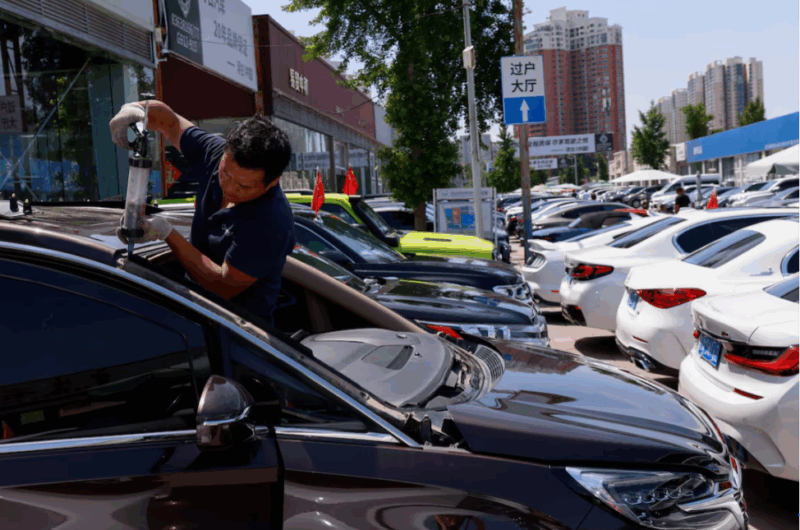
China’s auto industry has inflated car sales for years through a burgeoning government-backed grey market that registers new cars right off the assembly line and then ships them overseas as “used” vehicles.
These so-called “zero-mileage” cars have never been driven but they are being exported as used to markets like Russia, Central Asia and the Middle East, allowing Chinese automakers to show growth and to dispose of cars that it would be difficult to sell domestically, according to a Reuters review of government documents and interviews with five auto dealers and car traders.
“This is the outcome of an almost-four-year price war that has made companies desperate to book any sales possible,” said Tu Le, Michigan-based founder of consultancy Sino Auto Insights.
The practice only gained national attention after the boss of Chinese automaker Great Wall Motor (601633.SS), criticized the sale of zero-mileage used cars within China in May. On June 10 the People’s Daily newspaper condemned the sale of zero-mileage used cars domestically.
The paper, which often signals the positions of China’s top Communist Party leaders, blamed these fake used cars for driving down prices amid a withering domestic price war and called for “tough regulatory action” to restore order.
But the export and sale of fake used cars is actively encouraged by regional governments in China, according to a Reuters review of state media reports and government documents.
Local governments have embraced the practice as vital to meeting ambitious targets for economic growth set by Beijing, according to a Reuters review of local policy documents and state media articles.
Reuters has identified 20 local governments in China – including major export hubs like Guangdong and Sichuan – that have described their support for the export of zero-mileage used cars in publicly available government documents.
The tactics include creating extra licenses for the export of zero-mileage used cars, fast-tracking tax rebate claims, investing in export infrastructure, and funding networking events to encourage zero-mileage used-car exports, the government documents showed.
The zero-mileage used car export market works like this: as a fresh car emerges from the assembly line, an exporter buys the car either directly from the automaker or from a dealer, registers it with a Chinese license plate, and then immediately marks it as a second-hand car for shipping abroad. Along the way, the automaker books the car as sold and logs the revenue.
The support for the practice from local governments would make little sense anywhere outside China’s centrally planned economy. But here, showing rapid growth in sales and employment can bring about promotion or unlock new funding while missing economic targets that trickle down from Beijing can lead to demotions of local officials.
Because these export firms both purchase and sell a single car, the transaction value is double that of new or used-car purchases, so local governments court them to set up shop on their turf to quickly and artificially boost their GDP statistics, two Chinese auto industry executives said.
The tactic is only one sign that China’s car industry – the world’s largest – is allowing production to outpace demand, driving a protracted domestic price war and spurring accusations of automotive “dumping” abroad.
Cui Dongshu, the secretary general of the China Passenger Car Association, praised the practice earlier this month during an online panel discussion hosted by Tencent’s news portal, saying it was an alternative channel for automakers in China to access certain markets overseas that they may not be able to access due to rising trade barriers globally.
He added that it also helped to satisfy overseas demand for China-made cars in countries where Chinese brands had yet to enter.
Reuters contacted all the local governments mentioned in this article for comment but none responded. China’s State Council and commerce ministry did not respond to a request for comment. China’s foreign ministry referred queries on the practice to “the department in charge,” without elaborating.



