The future is now…and it’s tiny.
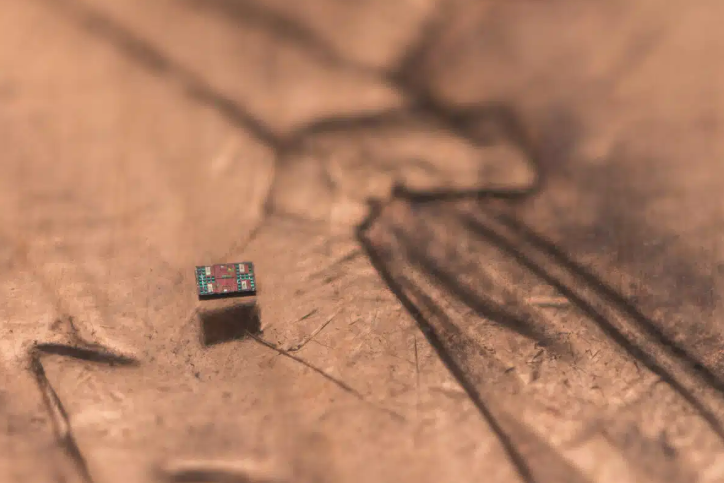
Robots the size of a single-celled organism can now sense their environment, make decisions, and act on them without any outside help. Researchers at the University of Pennsylvania and University of Michigan created microscopic machines measuring just 210 to 340 micrometers wide (roughly the size of a paramecium or two human hairs laid side by side) that pack in an onboard computer, temperature sensors, memory, communication systems, and propulsion.
Published in Science Robotics, the work marks the first reported demonstration of a fully integrated, task-specific onboard computer, environmental sensors, and locomotion systems in something this microscopically small. The robots operate without external control. These devices run on roughly 100 nanowatts of power, about the same energy budget as many living cells.
Previous attempts at building robots at cellular scales forced researchers to sacrifice key capabilities. Most microrobots either relied on external equipment like magnetic coils to control them, could only execute predetermined behaviors hard-coded during manufacturing, or lacked the ability to sense and respond to their surroundings. These new microrobots overcome all three limitations.
Built Like Computer Chips, Small as Cells
The research team manufactured their microrobots using the same semiconductor processes that create computer chips. About 100 robots fit on a single millimeter-scale chip that can rest on a gloved fingertip. Each individual robot contains a tiny processor, solar cells for harvesting power from light, temperature sensors, circuits for controlling movement, memory, and an optical receiver for wireless programming.
Power represents the primary constraint when working at cellular dimensions. Living cells have evolved molecular machinery to harvest and use energy efficiently at nanowatt levels. The research team had to match this biological efficiency. The processor alone consumes nearly 90% of the robot’s 100-nanowatt power budget and occupies about 25% of its body.
To work within these cellular-scale power limits, researchers designed a custom computer architecture that compresses robot actions into specialized instructions. Commands like “sense the environment” or “move for N cycles” execute in what appears to be a single operation. This compression makes meaningful tasks possible with just a few hundred bits of memory.
The robots demonstrated their autonomous capabilities through experiments that mirror how single-celled organisms navigate their environments. In one test, microrobots continuously measured surrounding temperature, converted readings to digital data, and transmitted results back to a base station by encoding information in their movement patterns.
When tested in a bath of gradually warming solution, the robots’ measurements matched those from standard temperature probes. The sensors achieved 0.3-degree Celsius resolution with about 0.2-degree accuracy despite their microscopic size. This performance exceeds most existing digital thermometers of comparable volume.
The second experiment tested whether robots could exhibit taxis, or directed movement toward or away from environmental stimuli that characterizes many microorganisms. Researchers programmed the microrobots to search for warmer regions when temperature dropped, then hold position when finding warmth.
Results showed responsive behavior driven by real-time sensor input. Robots initially rotated in place without an imposed gradient. When researchers cooled the local area, robots automatically switched to exploratory movements, traveling through their environment until locating warmer zones, where they resumed stationary rotation. Reversing the temperature gradient caused robots to reverse course. This showed responses to live environmental changes rather than a fixed movement script.
Moving at cellular scales requires different approaches than standard robotics. The robots use electrokinetic propulsion, passing current between oppositely charged platinum electrodes while immersed in fluid. Mobile ions surrounding the robot respond to this electric field. The ions drag fluid along, creating flow that propels the machine forward at 3 to 5 micrometers per second. Robots can travel in different directions or rotate by changing which electrodes are active.
Light-Based Programming
Getting instructions into robots the size of cells required wireless solutions. The team developed an optical communication system using light-emitting diodes to both power and program the devices. One LED wavelength provides energy that solar cells convert to electricity. A second wavelength transmits data by flashing patterns that robots interpret as binary instructions and write to onboard memory.
A graphical user interface automates the entire programming process. Researchers can define robot behaviors without writing low-level firmware code. The system can send initialization programs to configure basic functions or task programs that define operations. Once instructions load, the robots operate completely autonomously based on their internal program and sensor readings.
To prevent random light fluctuations from accidentally altering robot behavior, the communication protocol requires passcode sequences. Each robot recognizes both a global passcode common to all devices and a type-specific code for addressing particular subsets. This enables researchers to give different instructions to different robots, similar to how cells in a multicellular organism respond to different chemical signals.
Potential Medical Applications and Future Improvements
The robots’ ability to sense, process, and respond to temperature could support future applications in biological research and medical diagnostics. Operating at cellular scales, they probe thermal gradients in ways larger sensors cannot, fitting into microfluidic chambers or capillary tubes where traditional instruments fail.
The devices could potentially interface with living systems by positioning their aqueous environment near target tissues and allowing heat to flow between environments. Reading temperature without direct physical contact bypasses biocompatibility concerns that affect many implantable sensors. The current work demonstrates these capabilities in controlled laboratory conditions, not in living organisms.
The authors estimate that, at production scale, each robot could cost on the order of a penny. Combined with the simple programming system requiring only controllable light sources rather than specialized laboratory equipment, this low cost could make cellular-scale autonomous robotics accessible beyond well-funded research institutions.
The research team notes that more advanced applications will require improvements like new actuators for in-body operation or better power transfer methods. Moving to more advanced semiconductor processes would increase onboard memory about 100-fold, enabling programs approaching thousands of lines of code and supporting more sophisticated decision-making.
Source : https://studyfinds.org/cell-sized-robots-can-sense-decide-move/



