The ongoing shortage of commercial LPG cylinders in India, caused by energy supply disruptions from the Gulf, is impacting temples and religious institutions. Many have limited food offerings or sought alternative energy sources.
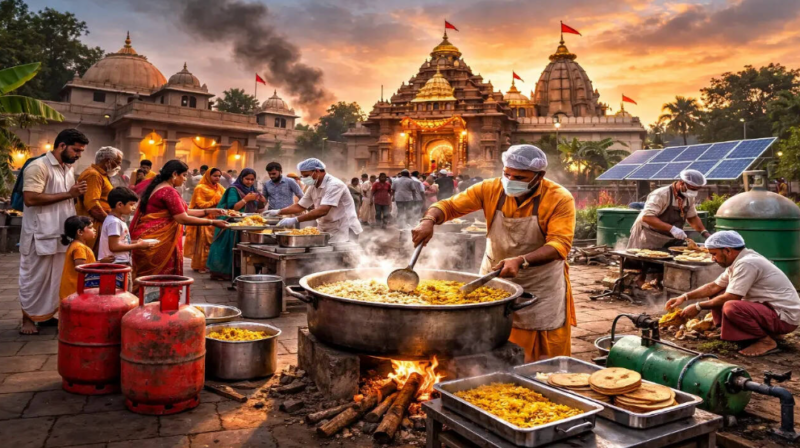
An ongoing shortage of commercial LPG cylinders, triggered by disruptions in energy supplies from the Gulf region, is beginning to affect temples and religious institutions across India, with several restricting food offerings to devotees while others turn to alternative fuel sources to continue services.
At Jagannath Mandir in Hauz Khas, New Delhi, temple authorities have temporarily stopped online bookings for Anna Prasad and sweets due to the cooking gas shortage.
In a notice issued to devotees, the temple management said, “Due to the current Government restrictions on cooking gas supply, the online booking of Anna Prasad and Sweets at Jagannath Mandir, Hauz Khas is temporarily closed until further orders. We regret the inconvenience and request your kind understanding and cooperation. Updates will be shared once the situation normalizes.”
The LPG crunch is linked to the ongoing conflict in West Asia, which has disrupted energy supplies passing through the Strait of Hormuz — a key global shipping route for oil and gas.
While some temples have been forced to scale down or suspend food services, others are finding ways to keep traditions alive.
Belur Math in West Bengal’s Howrah district has continued distributing bhog to thousands of devotees by relying on alternative energy sources such as biogas and solar power, according to news agency PTI. Belur Math, the headquarters of the Ramakrishna Math and Ramakrishna Mission, serves meals daily to large numbers of visitors, residents and devotees as part of its long-standing tradition of community service inspired by the teachings of Swami Vivekananda.
A senior monk said the temple has managed to keep its kitchen functioning because it does not rely entirely on LPG cylinders.
“As we do not solely rely on LPG cylinders for cooking, we have been able to keep our commitment and service to devotees unhindered. We have fully tapped other energy resources,” the monk said, according to PTI.
“One of the key alternatives is a biogas plant that produces fuel from waste generated at our cowshed. The organic gas generated from cattle waste meets a substantial portion of the kitchen’s cooking requirements,” the monk said.
In addition, a large solar power installation on the campus generates electricity that is used for heating water and supporting electrical cooking processes.
However, the situation is more challenging for other temples that rely heavily on LPG.
In Uttar Pradesh, Congress leader Ajay Rai claimed that the LPG shortage had forced the closure of the “Maa Annapurna Ki Rasoi” in Kashi, which serves food to large numbers of people every day.
“What kind of blow is this to the centuries-old traditions of Kashi, Narendra Modi ji? It is a matter of deep anguish that, due to a severe shortage of LPG, even Kashi’s sacred ‘Maa Annapurna Ki Rasoi’ has been forced to shut down today. A door from where no one ever returned hungry, today even sadhus, saints, and devotees are being compelled to go back without a meal,” Rai wrote on X.
Temple officials also confirmed that cooking operations had been severely affected.
Mahant Shankar Giri Maharaj said that earlier the temple received one or two gas cylinders regularly but the supply has now stopped.
“One of our two operational units has been shut since morning, and the second unit is also on the verge of closure,” he said.
Before the crisis, the temple served meals to 20,000 to 25,000 people every day, but now arrangements could be made for only about 3,000 devotees, he said.
Local authorities, however, said the shortage claims were exaggerated. Varanasi District Magistrate Satyendra Kumar said there was no shortage of LPG in the city and assured that gas would be supplied to the temple soon. He also warned people against spreading “rumours” about a gas shortage, reports PTI.
The shortage is also affecting temples in Karnataka, where several major shrines have reported difficulties in preparing prasada for devotees.
About 15 major Muzrai temples in the state are facing operational challenges due to the shortage of commercial LPG cylinders, according to The Hindu.
At the well-known Banashankari temple in Bengaluru, which usually serves meals to 3,000 to 5,000 devotees daily, officials say the shortage has created difficulties in running the temple kitchen. “Due to the shortage, we are facing some difficulty in preparing prasada. However, we are making sure that devotees are served and will make arrangements somehow,” temple kitchen manager Devraj said.



