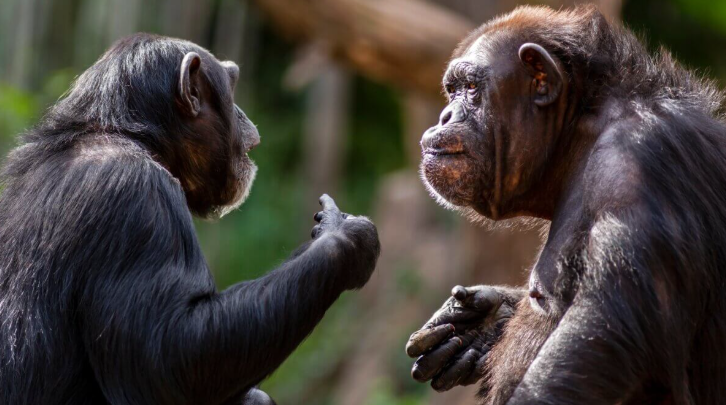
Chimpanzees can weigh and rationalize conflicting information before deciding what to believe. That’s the main conclusion of research that tested whether our closest living relatives can do something scientists call “rational belief revision,” a thinking skill previously thought to set humans apart.
Researchers at UC Berkeley, the University of Portsmouth, and other institutions designed a series of clever experiments with 15 to 23 chimpanzees at Ngamba Island Chimpanzee Sanctuary in Uganda. The chimps watched as food was hidden in boxes, then received different types of clues about where to find it. Sometimes they saw the food directly through a glass window. Other times they only heard it rattling around inside a box or saw traces of it left behind.
After the chimps chose a box based on one piece of evidence, researchers gave them a second, contradictory clue pointing to a different location. The question was whether the apes would stick with their first choice or change their minds, and more importantly, whether they’d make that decision in a smart, strategic way.
The chimps didn’t flip-flop randomly as one might expect. They stayed committed to their initial belief when the first evidence was strong and the contradicting evidence was weak. But when the situation reversed and weaker evidence came first, they readily changed their minds after receiving stronger proof pointing elsewhere.
Chimpanzees Use Rational Thinking, Not Random Guessing
In one experiment, chimps heard food shaking in one box, then saw food directly in another box through a clear panel. Most switched their choice to the box where they’d seen the food, recognizing that visual proof beats auditory hints. In another version, they saw food traces near one box, then heard rattling in another. Again, they favored the stronger evidence, in this case the sound of actual food over mere leftovers.
Study authors wanted to know if chimps were truly thinking about evidence or just responding to whatever seemed flashiest. So they ran a test with three boxes: one with strong evidence, one with weak evidence, and one with no evidence at all. After showing the chimps all three options, they removed the box with strong evidence. If the animals were only paying attention to the most obvious cue, they should have chosen randomly between the two remaining boxes. Instead, they consistently picked the box supported by weak evidence over the one with none, suggesting they were tracking more than one possibility all along.
The researchers point out that changing your mind based on evidence strength requires keeping track of not just what you know, but how you know it.
Telling Real Information From Noise
Perhaps most impressively, the chimps could tell the difference between genuinely new information and redundant evidence. When researchers shook a box twice, the chimps recognized this as the same piece of evidence presented again. It didn’t make them more likely to pick that box. But when researchers dropped two separate pieces of food into a box one after another, creating two distinct sounds, the chimps treated this as accumulating evidence and were more likely to revise their choice.
The animals changed behavior when their original evidence was undercut. In one test, after a chimp chose a box where it had seen food through a window, researchers revealed that the window actually showed a picture of food, not real food. This undercut the earlier visual cue; chimps treated it as weaker and were more willing to switch boxes. When researchers revealed an empty window instead of a picture, which didn’t change anything about what they’d seen, the chimps mostly stuck with their choice.
Why This Matters for Animal Intelligence
Previous research showed that great apes could figure things out based on various types of clues. A hungry chimp might locate hidden food by listening to sounds, looking at visual hints, or noticing that food is absent from other spots. But those abilities could be explained by simpler mental shortcuts that don’t require actually reasoning about how trustworthy different sources of information are.
This study, published in Science, goes further. The chimps went beyond simply responding to evidence — they took time evaluating it. When deciding whether to stick with or abandon a belief, they compared the strength of competing pieces of information.
The research team used mathematical models to predict how a perfectly rational thinker should behave when faced with conflicting evidence of different strengths. The chimps’ behavior matched these predictions remarkably well, not just overall but for nearly every individual animal tested.
These results show that the ability to weigh evidence and change your mind accordingly likely has deep evolutionary roots among great apes.
The study also addresses a longstanding debate about whether animals can truly think about their own thinking, or if they just happen to behave in ways that look smart. Critics have argued that when chimps search for more information or skip difficult tasks, they’re not really reflecting on their own knowledge—they’re just reacting to uncertainty in ways that mimic deeper thought.
But the experiments in this study make that skeptical explanation harder to accept. Recognizing when a piece of evidence has been proven wrong by later information requires understanding the relationship between evidence and belief, not just reacting to whatever’s in front of you.
Source : https://studyfinds.org/are-chimpanzees-rational-thinkers/



