The Indian Air Force established decisive air superiority over Pakistan during Operation Sindoor. This dominance forced Pakistan to seek a ceasefire, ending the conflict within four days.
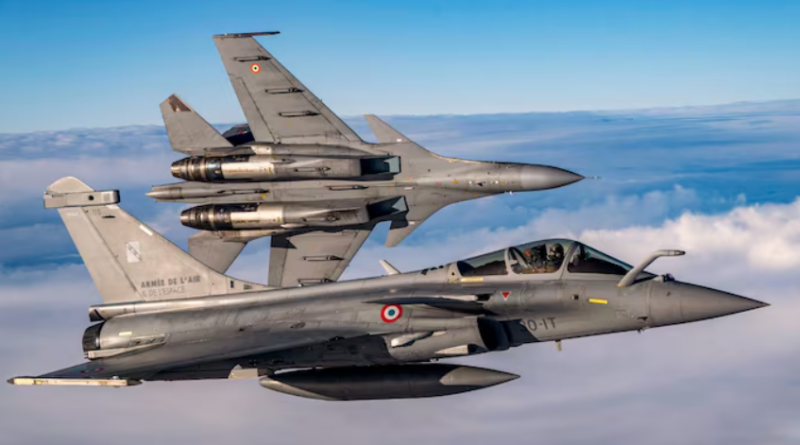
The Indian Air Force (IAF) established decisive air superiority over large swathes of Pakistan during Operation Sindoor, executing deep strikes and inflicting significant damage that compelled Islamabad to seek a ceasefire within days in May last year, according to a detailed assessment by a Switzerland-based military think tank.
The 47-page report, prepared by the Centre for Military History and Perspective Studies (CHPM), says Pakistan was effectively “coerced” into agreeing to a ceasefire after losing the ability to contest Indian air operations during the four-day conflict.
By the final phase of the engagement, the IAF enjoyed the freedom to conduct long-range precision strikes at will, while the Pakistan Air Force (PAF) had lost the capability to mount effective counter-attacks, the report notes. By the morning of May 10, Indian air superiority enabled sustained strikes deep inside Pakistani territory using long-range munitions such as BrahMos and SCALP-EG missiles.
In contrast, Pakistani air operations were severely constrained following the loss of forward surveillance radars and the threat posed by India’s S-400 air defence systems, particularly to Pak Air Force airborne early warning aircraft.
According to the study, the IAF launched two strike packages on the night of May 7, deploying Rafale and Mirage-2000 fighter jets to target the headquarters of Jaish-e-Mohammed in Bahawalpur and Lashkar-e-Taiba in Muridke. One strike formation reportedly penetrated Pakistani airspace at low altitude before executing a pop-up attack designed to draw interception.
Pakistan responded by scrambling more than 30 fighter aircraft and firing PL-15 long-range air-to-air missiles, with Rafales identified as priority targets, the document says.
PAK’S AIRCRAFT LOSS CLAIMS WITHOUT EVIDENCE
While Pakistan claimed it had shot down six Indian aircraft, the Swiss assessment says visual evidence supports the loss of only one Rafale, one Mirage-2000 and one additional fighter, assessed as either a MiG-29 or a Su-30MKI. India has rejected Pakistan’s claims of Indian aircraft losses.
The report also notes the recovery of multiple PL-15 missile casings on Indian territory, suggesting that several IAF pilots successfully evaded incoming missiles.
DRONE OFFENSIVE BLUNTED
Beginning May 7, Pakistan launched a large-scale drone and missile offensive, deploying more than 300 drones in the first wave and around 600 in the second, along with artillery rockets, ballistic missiles and air-launched munitions. Targets included Indian Army positions, air bases, logistics hubs and air-defence systems.
The objective, the report says, was to force Indian radars to activate so they could be mapped and neutralised. However, India’s layered air-defence network — supported by jamming, spoofing and sensor fusion — intercepted most threats. More than half of the drones were reportedly brought down by anti-aircraft guns alone.
The study credits the integration of the IAF’s Integrated Air Command and Control System with the Army’s Akashteer network, enabling Indian forces to activate radars only briefly and deny Pakistan accurate triangulation of air-defence positions. Despite repeated attempts, Pakistan failed to map India’s electronic order of battle.



